Map Turtle Care Guide
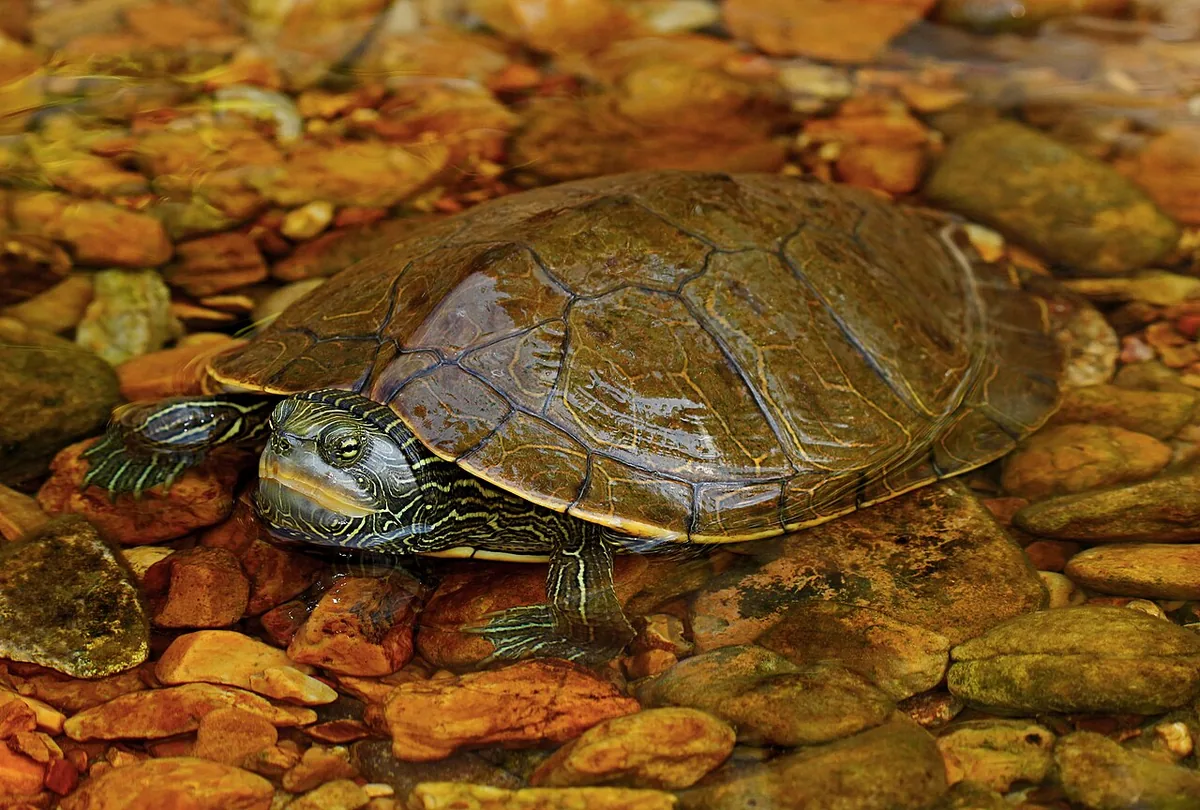
A riverine basking turtle with fine contour-line shell markings. Two things separate them from sliders: they are noticeably less tolerant of poor water quality, and females grow to roughly twice the length of males, which transforms the tank you need.
Map Turtle at a glance
| Adult size | Males ~5 in · females up to 12 in |
| Lifespan | 15-30+ years |
| Enclosure | Large aquarium; 600 L or more for an adult female |
| Filtration | Strong, oversized, producing noticeable current |
| Water quality | More demanding than sliders; the key requirement |
| Basking | Dry basking site with heat and UVB |
| Diet | Highly carnivorous: crayfish, snails, insects, worms |
| Handling | Display animal; they are fast and dislike restraint |
| Experience | Intermediate |
What most map turtle care sheets get wrong
These are the errors that show up most often in secondary care sheets and forum advice. Each one is a real welfare issue, not a preference.
They are not hardy like a slider, and that is the whole point.
Map turtles look like a slightly different slider and get bought on that basis. They come from clear, fast-flowing rivers and are noticeably less tolerant of poor water conditions than sliders and other common aquatic turtles. Shell and skin infections follow water quality lapses that a slider would shrug off. Oversized filtration and a real current are requirements rather than refinements.
The tank you need depends on a coin flip you cannot see.
Male map turtles reach around five inches; females can reach twelve. That is not a modest difference, it is a completely different aquarium, with adult females commonly quoted as needing 600 litres or more. Sexing is not reliable in hatchlings, so anyone buying a young map turtle should plan for the female outcome or accept the risk.
Carnivorous does not mean pellet-fed.
Map turtles are highly carnivorous, with crayfish, snails, insects and worms forming much of the natural diet. Snails in particular suit the broad-headed species. A pellet-only diet is as inadequate here as it is for any aquatic turtle, and it also misses the calcium that shelled prey provides.
Why keep a map turtle
- Fine contour-line shell markings that give the group its name
- Active, strong swimmers that use the whole water column
- Dedicated baskers, so they are visible and easy to observe
- Males stay genuinely small, which suits keepers with limited space
Why you might not want one
- Water quality sensitivity means serious filtration and maintenance
- An adult female needs an enormous volume of water
- Sexing hatchlings is difficult, so you may not know which you are getting
- Not a species that tolerates the shortcuts a slider might
Common questions
How big do map turtles get?
It depends heavily on sex. Males typically reach around five inches, while females can reach twelve. That difference dictates the size of aquarium required, and because hatchlings are difficult to sex, buyers should plan for the larger outcome.
Are map turtles harder to keep than red-eared sliders?
In one important respect, yes. Map turtles are noticeably less tolerant of poor water quality than sliders, because they come from clear, fast-flowing rivers. They need stronger filtration and more consistent maintenance, and they respond to lapses with shell and skin problems.
What do map turtles eat?
They are highly carnivorous. Crayfish, snails, insects and worms make up much of the diet, supplemented with commercial pellets and some plant matter. Snails are particularly well suited to the broad-headed species and supply useful calcium.
How much water does a map turtle need?
A great deal, particularly for females. Adult females are commonly quoted as needing 600 litres or more, especially if kept in groups. Males, at around five inches, need considerably less, but sexing hatchlings reliably is difficult.
Do map turtles need a basking area?
Yes. They are dedicated baskers and need a dry basking site with appropriate heat and UVB, alongside the strong filtration and current their water section requires. Both halves of the setup matter.