Map Turtle Enclosure and Habitat
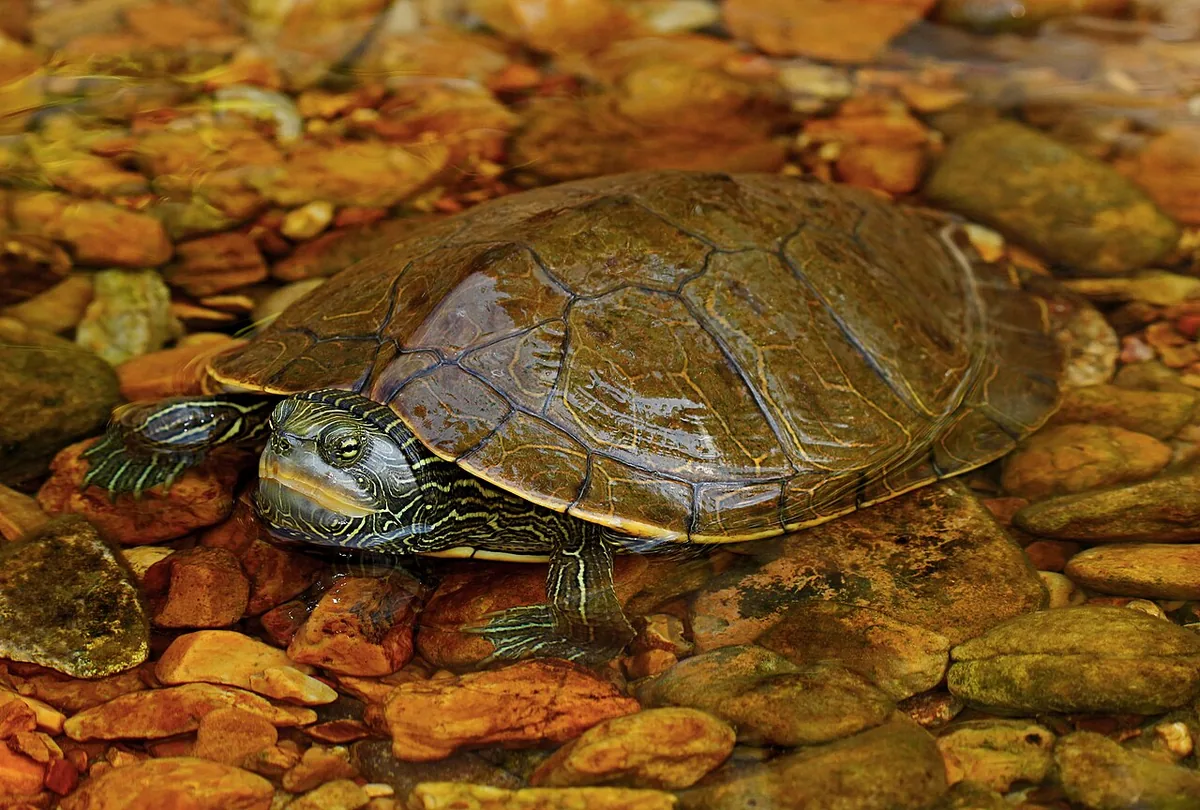
Map turtles are riverine and noticeably less tolerant of poor water than sliders. The tank question is complicated by the fact that adult females can reach twice the length of males, and you usually cannot tell which you have as a hatchling.
What published sources give
| Figure | Size | Notes |
|---|---|---|
| Adult female | 600 litres or more | From this site's care guide, especially in groups |
| Size dimorphism | Males ~5 in · females up to 12 in | Decides the tank required |
| Filtration | Strong, producing noticeable current | They come from clear fast-flowing rivers |
| Water quality | Less tolerant than sliders | The defining husbandry point |
Checked September 20, 2026. Where sources differ the range is shown rather than averaged. These are the figures published as minimums; none of them is a maximum.
What changes as they grow
Hatchling and juvenile
Sexing is unreliable at this stage, which is the problem. Plan for the female outcome or accept the risk of a much larger adult.
Adult
600 litres or more for a female. A male at around five inches needs considerably less, but you will not know for certain for some time.
Enclosure mistakes specific to this species
Filtration sized for fish rather than turtles
Aquatic turtles produce far more waste than fish of the same size, and they eat in the water. Under-filtering shows up as shell and skin infections before it shows up as cloudy water.
A basking area that never fully dries
Aquatic turtles must be able to leave the water and dry off completely under heat and UVB. A platform that stays wet defeats the purpose and contributes directly to shell problems.
UVB mounted outside glass, or left in past its life
Glass filters UVB out, and bulbs lose output within 6 to 12 months while still looking lit. In shelled species this shows up as soft shell and metabolic bone disease, which is slow to appear and hard to reverse.
Treating them as hardy like sliders
Map turtles are specifically described as less tolerant of poor water conditions than sliders. Shell and skin infections follow lapses that a slider would shrug off, so filtration should be oversized rather than adequate.
Sizing the tank before you know the sex
The difference between a five-inch male and a twelve-inch female is not a modest upgrade, it is a different aquarium. Plan for the larger outcome.
Enclosure hazards that apply to almost every setup
Five hazards come up across nearly every species on this site: contact burns from unguarded heat, UVB that never reaches the animal, cutting ventilation to hold humidity, unsecured decor, and trusting a bulb's wattage instead of a thermometer. They are set out in full, with sources, on our enclosure hazards page, which is worth reading once against any setup including one that looks finished.
Signs the enclosure is wrong
Animals tell you about their housing through behaviour before they tell you through illness. None of these is a diagnosis; each is a reason to look at the enclosure and, where noted, to call a vet.
| What you see | What it can mean |
|---|---|
| Shell or skin lesions | Water quality, and this species shows it sooner than sliders. Veterinary attention. |
| Reduced feeding with no other sign | Check water parameters first in this species. |
| Never basking | Check platform access and that it dries fully. |
| Water fouling quickly | Filtration undersized for a messy, sensitive species. |
Common questions
How big a tank does a map turtle need?
Adult females are commonly quoted as needing 600 litres or more, particularly in groups, while males at around five inches need considerably less. Because sexing hatchlings is unreliable, planning for the female outcome is the safer approach.
Are map turtles harder to keep than sliders?
In one important way, yes. They come from clear, fast-flowing rivers and are noticeably less tolerant of poor water quality, so they need stronger filtration, real current and more consistent maintenance.
Do map turtles need a current in the tank?
They come from fast-flowing rivers and strong filtration producing noticeable current is commonly recommended, both for water quality and because it suits the environment they evolved in.