Indian Star Tortoise Care Guide
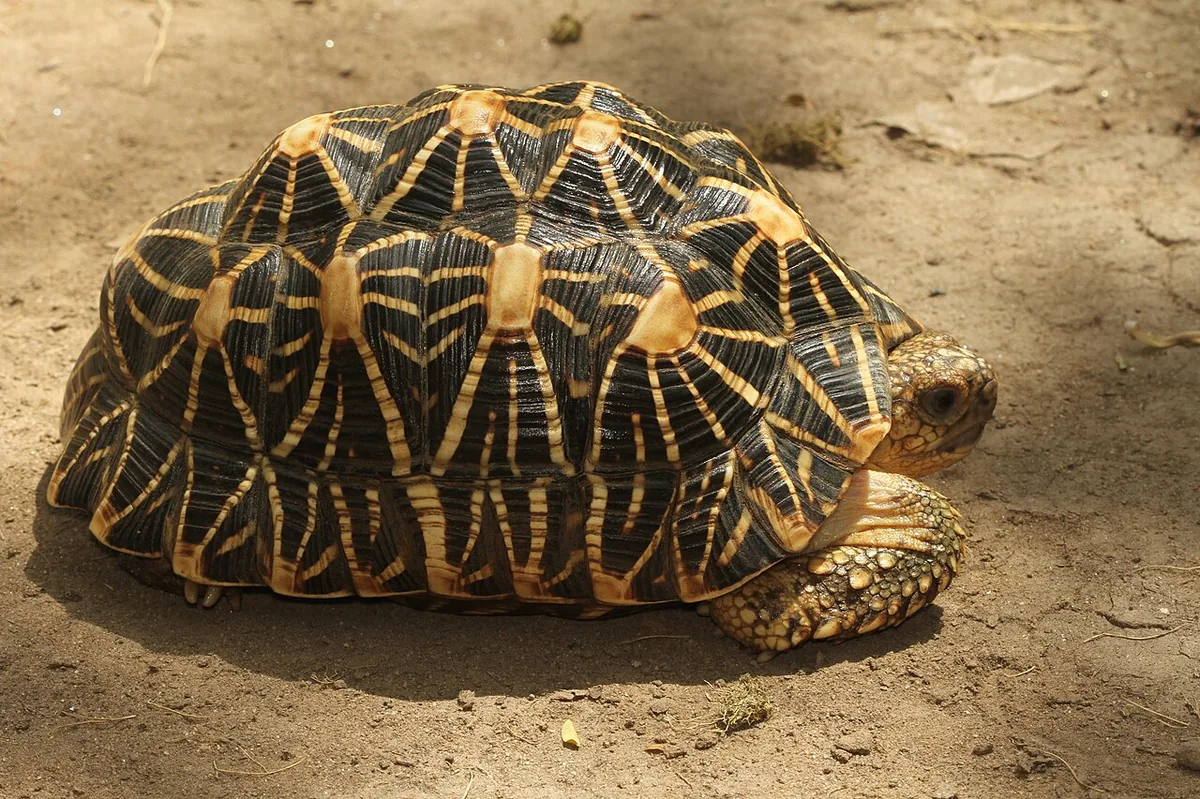
A strikingly patterned grazing tortoise from India and Sri Lanka, and the most trafficked tortoise species in the world. The husbandry is manageable. The thing that actually matters before you buy one is where the animal came from.
Indian Star Tortoise at a glance
| Adult size | Females 10-12 in · males smaller, around 6-8 in |
| Lifespan | 30-50+ years |
| Enclosure | Large floor space; outdoor grazing where climate allows |
| Temperature | Cool end ~77°F · basking 95-104°F |
| Humidity | 40-75%, higher for juveniles |
| UVB | Required |
| Diet | Grasses, weeds and leafy greens; herbivorous |
| Legal status | CITES Appendix I |
| Experience | Intermediate, with a serious provenance caveat |
What most indian star tortoise care sheets get wrong
These are the errors that show up most often in secondary care sheets and forum advice. Each one is a real welfare issue, not a preference.
Where the animal came from is the most important question about this species.
Indian star tortoises are on CITES Appendix I, having been uplisted from Appendix II in 2019 after advocacy from India, Sri Lanka, Bangladesh and Senegal. International commercial trade is banned. Despite that, it remains the most smuggled tortoise species in the world, with animals taken from the wild in very large numbers. A buyer who does not ask about provenance is, in practice, part of the demand that drives it. Buy captive-bred, from a breeder who can document it.
They need more humidity than their look suggests.
The high-domed shell and star pattern read as desert animal, and keepers house them accordingly. Indian star tortoises need moderate humidity, roughly 40 to 75 percent, and juveniles particularly need the higher end. Too-dry conditions contribute to respiratory problems and poor shell development in growing animals.
The pattern is camouflage, not decoration.
The radiating star pattern breaks up the tortoise's outline in dry grassland, which is also why it is so heavily targeted by collectors. It is worth knowing that the feature people buy them for is the reason the species is under pressure.
Why keep an indian star tortoise
- One of the most beautiful shell patterns of any tortoise
- Manageable adult size compared with sulcatas or leopard tortoises
- Long-lived and, in good conditions, hardy
- Captive-bred populations do exist and are the right way to keep one
Why you might not want one
- The trade around this species funds large-scale wildlife trafficking
- Humidity requirements are higher and more particular than most arid tortoises
- Wild-caught animals arrive stressed, dehydrated and heavily parasitised
- Decades-long commitment
Common questions
Are Indian star tortoises legal to own?
The species is listed on CITES Appendix I, which bans international commercial trade. Legality of ownership depends on your country and on the animal's documented provenance. Captive-bred animals with proper paperwork are the only defensible way to keep one.
Why are Indian star tortoises so heavily trafficked?
Their star-patterned shells make them highly sought after in the pet trade, and despite the 2019 uplisting to CITES Appendix I they remain the most smuggled tortoise species in the world. Large numbers are taken from the wild in India and Sri Lanka.
What temperature do Indian star tortoises need?
A gradient from roughly 77°F at the cool end to between 95 and 104°F at the basking site, with UVB and a proper day-night cycle. Humidity should sit around 40 to 75 percent, with juveniles needing the higher end of that range.
What do Indian star tortoises eat?
They are herbivorous grazers. Grasses, weeds and leafy greens form the diet, as with other grazing tortoises. Animal protein should not be offered, and fruit should be rare.
How big do Indian star tortoises get?
Females typically reach 10 to 12 inches and males are noticeably smaller at around 6 to 8 inches. That makes them far more manageable than sulcatas or leopard tortoises while still being a decades-long commitment.