← Indian Star Tortoise care guide
Indian Star Tortoise Enclosure and Habitat
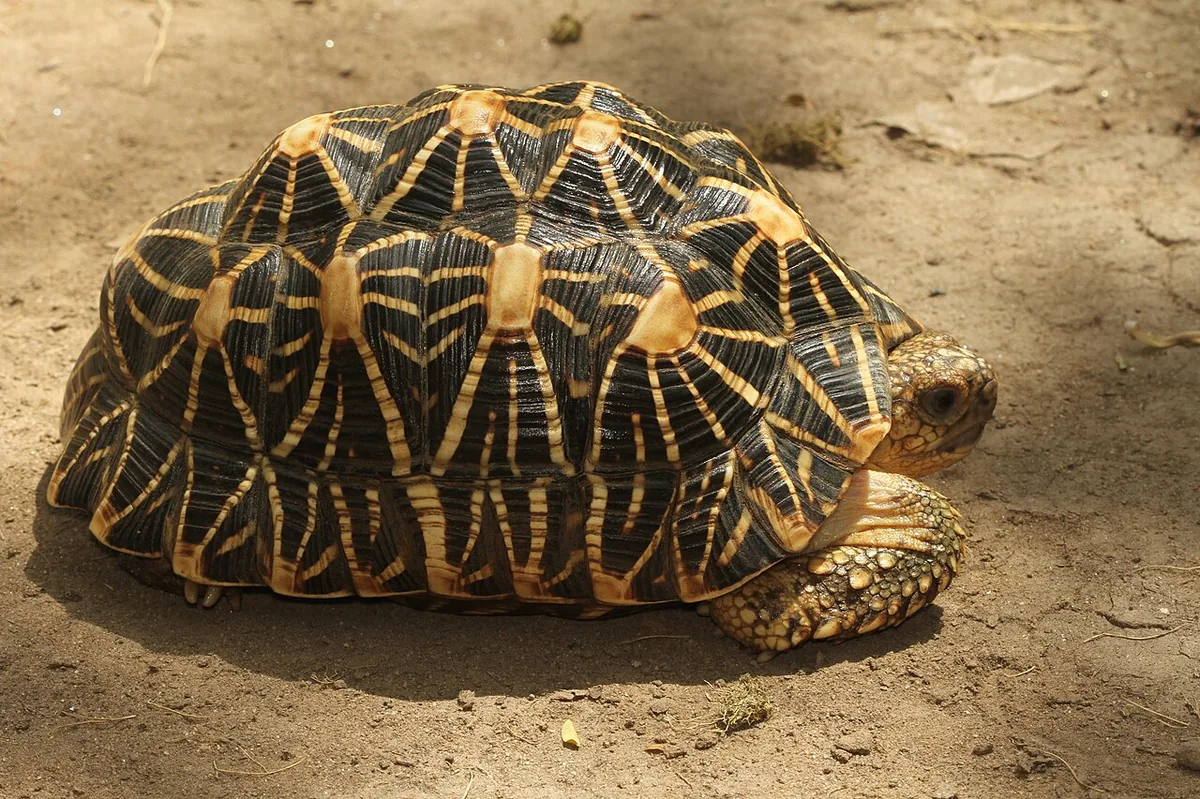
Indian star tortoises need more humidity than their high-domed, arid-looking shell suggests, and the published range is wide because juveniles need considerably more than adults.
What published sources give
| Figure | Size | Notes |
|---|---|---|
| Housing | Large floor space; outdoor grazing where climate allows | From this site's care guide |
| Humidity | 40-75%, juveniles at the higher end | Higher than most arid tortoises |
| Temperature | Cool end ~77°F · basking 95-104°F | Published gradient |
Checked September 20, 2026. Where sources differ the range is shown rather than averaged. These are the figures published as minimums; none of them is a maximum.
What changes as they grow
Hatchling and juvenile
Higher humidity is specifically needed during growth, and dryness contributes to respiratory problems and poor shell development.
Adult
Large floor area with grazing. Females reach 10-12 inches and males 6-8, so the space requirement is moderate compared with sulcatas or leopard tortoises.
Enclosure mistakes specific to this species
A boundary that is not sunk into the ground
Tortoises dig. A fence that starts at ground level is an invitation, and the animal has all day. Sinking the barrier is standard advice for outdoor pens.
Building a desert enclosure
The star pattern reads as desert animal and keepers house them accordingly. Published humidity for this species runs 40 to 75 percent, with juveniles at the top end. Too dry is a real risk here.
Buying before asking about provenance
Not strictly an enclosure point, but it belongs on any page about this species. They are CITES Appendix I and the most smuggled tortoise in the world, so a wild-caught animal is likely to arrive dehydrated and parasitised whatever enclosure waits for it.
UVB mounted outside glass, or left in past its life
Glass filters UVB out, and bulbs lose output within 6 to 12 months while still looking lit. In shelled species this shows up as soft shell and metabolic bone disease, which is slow to appear and hard to reverse.
Enclosure hazards that apply to almost every setup
Five hazards come up across nearly every species on this site: contact burns from unguarded heat, UVB that never reaches the animal, cutting ventilation to hold humidity, unsecured decor, and trusting a bulb's wattage instead of a thermometer. They are set out in full, with sources, on our enclosure hazards page, which is worth reading once against any setup including one that looks finished.
Signs the enclosure is wrong
Animals tell you about their housing through behaviour before they tell you through illness. None of these is a diagnosis; each is a reason to look at the enclosure and, where noted, to call a vet.
| What you see | What it can mean |
|---|---|
| Dry or flaking skin, reluctance to move | Humidity below what this species needs. |
| Wheezing or nasal discharge | Respiratory problems, which dryness contributes to. Veterinary attention. |
| Pyramided growth in a juvenile | Humidity as much as diet. |
| Soft shell or rubbery limbs | Metabolic bone disease. Veterinary attention. |
Common questions
What enclosure does an Indian star tortoise need?
Large floor space with outdoor grazing where climate allows, a temperature gradient from around 77°F at the cool end to 95-104°F basking, and humidity between roughly 40 and 75 percent.
Do Indian star tortoises need humidity?
More than their appearance suggests. Published humidity runs 40 to 75 percent with juveniles needing the higher end, which is considerably more than arid species like sulcatas or Russian tortoises.
How big do Indian star tortoises get?
Females typically reach 10 to 12 inches and males around 6 to 8, which makes their space requirement moderate compared with sulcatas or leopard tortoises.