Carpet Python Care Guide
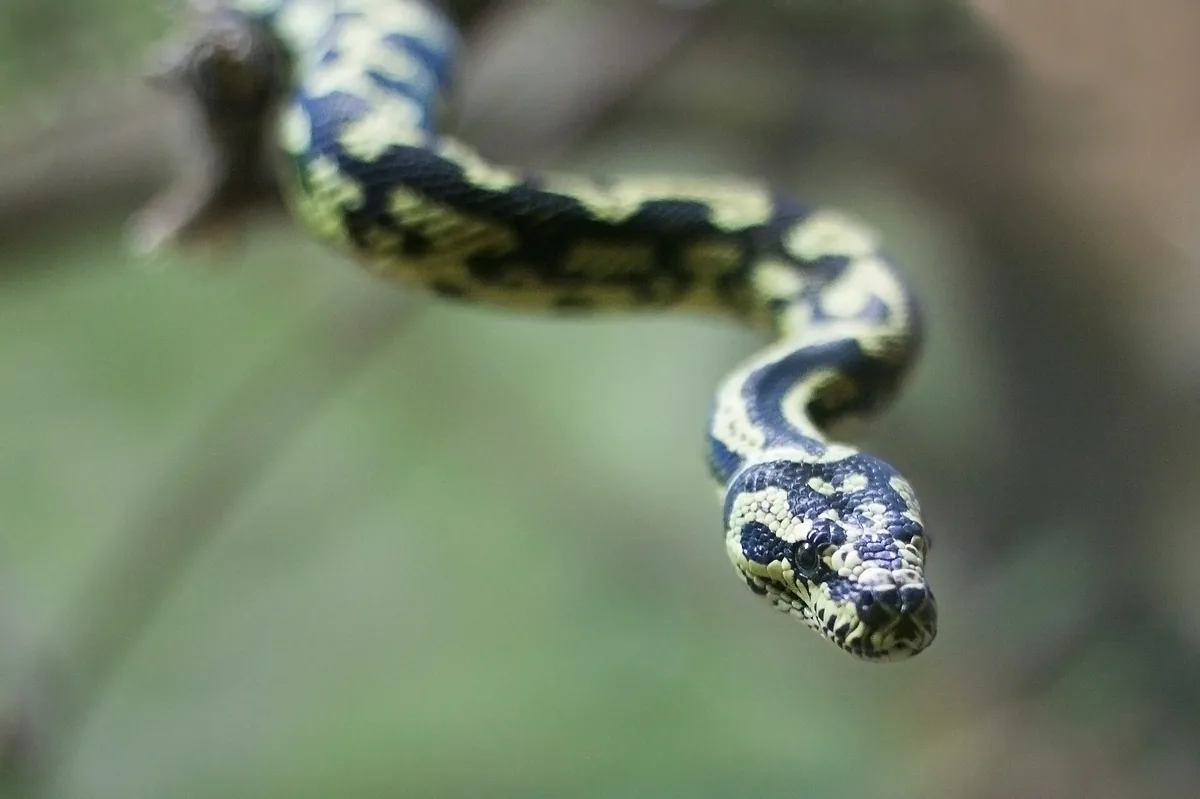
A semi-arboreal Australian python that is genuinely beautiful, long-lived, and manageable, provided you know which subspecies you bought. Adult size ranges from about 5 feet to over 8 feet depending on locality.
Carpet Python at a glance
| Adult size | 5-9 ft depending on subspecies (~6.5 ft typical) |
| Lifespan | 15-20 years, up to 30 |
| Enclosure | ~4 x 2 x 2.5 ft for an adult, with climbing branches |
| Temperature | Warm side 86-93°F · cool side 72-79°F |
| Humidity | 50-60% (M. bredli 30-50%) |
| UVB | Not required; low-level UVB increasingly recommended |
| Diet | Appropriately sized rodents, every 1-2 weeks as adults |
| Handling | Tolerant as adults; juveniles are nippy and food-driven |
| Experience | Intermediate |
What most carpet python care sheets get wrong
These are the errors that show up most often in secondary care sheets and forum advice. Each one is a real welfare issue, not a preference.
"Carpet python" is not one size of snake.
Care sheets that give a single adult length for Morelia spilota are misleading. A jungle carpet (M. s. cheynei) often matures around 5 to 6 feet. A coastal carpet (M. s. mcdowelli) can exceed 8 feet and needs a substantially larger enclosure and a different feeding plan. Ask the breeder for the subspecies and the parents' adult sizes.
Nippy juveniles are a life stage, not a temperament.
Carpet pythons have a reputation for being aggressive that comes almost entirely from hatchlings and yearlings, which are small, prey-driven, and defensive. The overwhelming majority calm down substantially as adults with consistent, unhurried handling. Judging the species by a baby is judging it at its worst.
Humidity is not one number across the group.
Most subspecies do well at 50 to 60 percent, but the centralian carpet (M. bredli) comes from arid inland Australia and does better at 30 to 50 percent. Running a bredli at rainforest humidity invites respiratory problems, which is the opposite of the usual advice to raise humidity when something is wrong.
Why keep a carpet python
- Semi-arboreal, so a tall planted enclosure is used rather than decorative
- Enormous natural variation: jungle, coastal, Darwin, bredli, diamond
- Long-lived and hardy once established
- Adult temperament is generally calm and predictable
- Australian origin means the captive population is entirely captive bred
Why you might not want one
- Juveniles are genuinely nippy. This is normal and it passes, but it surprises new keepers
- Strong feeding response, so a hook and deliberate handling routine matter
- Coastal and diamond animals get large enough to need a custom enclosure
- 15-30 year commitment
Common questions
How big do carpet pythons get?
It depends entirely on subspecies. Jungle carpets typically mature around 5 to 6 feet, the common average across the group is about 6.5 feet, and coastal carpets can reach 8 to 9 feet. Confirm which subspecies you are buying, because it changes the enclosure and the budget.
Are carpet pythons aggressive?
Adults generally are not. Hatchlings and juveniles are defensive and have a strong feeding response, which is where the reputation comes from. With regular, calm handling most individuals become reliable adult snakes. Use a hook to signal handling time rather than reaching straight into the enclosure.
What size enclosure does a carpet python need?
An adult needs roughly 4 feet long by 2 feet deep by 2.5 feet tall, with sturdy horizontal branches. They are semi-arboreal and genuinely use vertical space, so height is not decorative here. Large coastal carpets need more than this baseline.
What temperature should a carpet python enclosure be?
Provide a gradient: a warm side of 86 to 93°F and a cool side of 72 to 79°F. A thermostat is not optional. Unregulated heat mats and ceramic emitters are a leading cause of thermal burns in captive snakes.
How long do carpet pythons live?
Fifteen to twenty years is normal with good husbandry, and individuals have reached about 30 years in captivity. Treat this as a two-decade commitment and think about who cares for the animal if your circumstances change.
How often do carpet pythons eat?
Adults take an appropriately sized rodent every one to two weeks; growing juveniles eat more often. Obesity from overfeeding is more common in captivity than underfeeding, so judge by body condition and muscle tone rather than by a fixed schedule.