Ball Python Morphs: What They Are, and Which Ones Carry Health Risks
The short answer
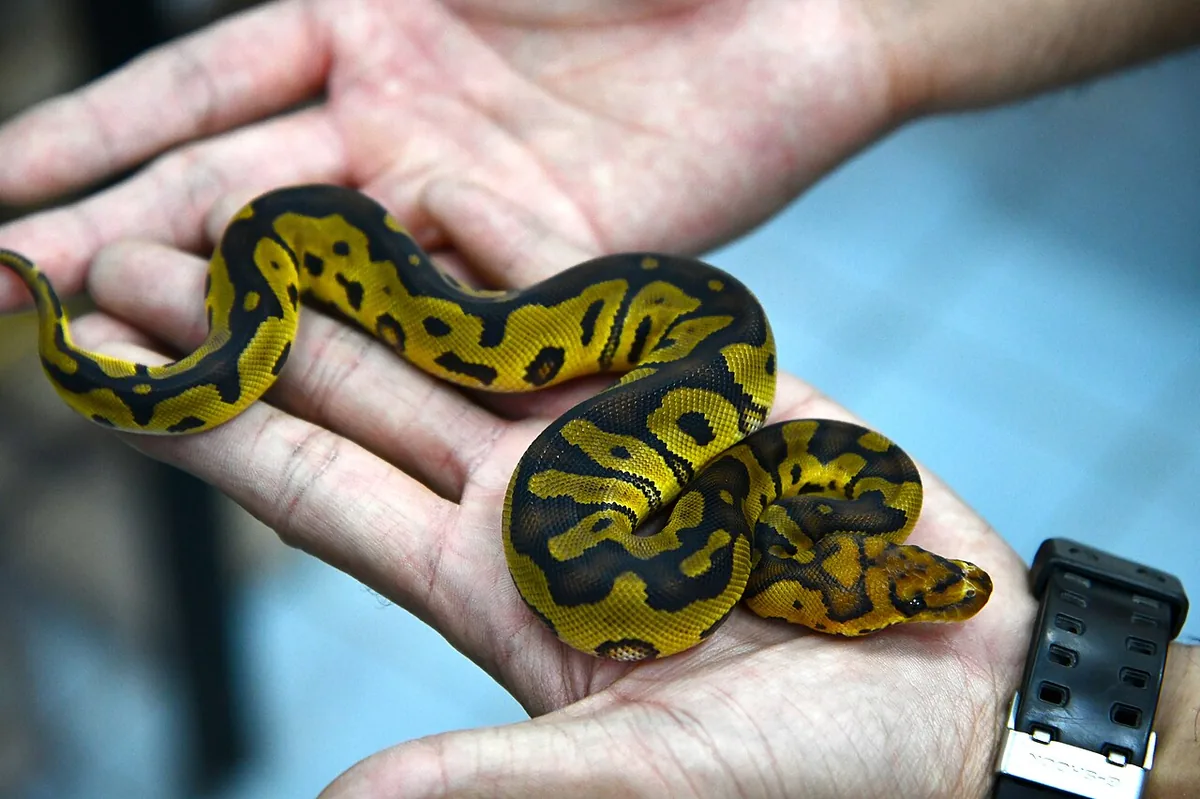
A ball python morph is an inherited colour or pattern variation produced by selective breeding. Most are cosmetic and carry no health consequence. A small number do not: the spider morph is associated with a neurological condition called wobble syndrome, documented in the veterinary literature, and several homozygous “super” forms are linked to structural defects or are not viable at all.
How morph genetics work
| Inheritance | What it means | Examples |
|---|---|---|
| Recessive | Two copies needed to show. One copy is a het (heterozygous) carrier that looks normal. | Albino, Piebald, Clown, Ghost |
| Incomplete dominant | One copy shows; two copies produce a visually distinct “super” form. | Pastel (super pastel), Cinnamon, Black Pastel, Fire (super fire / black-eyed leucistic) |
| Dominant | One copy shows. Two copies look the same as one, or are not viable. | Spider, Pinstripe |
| Polygenic / line-bred | Appearance built up by selective breeding rather than one gene. | Reduced pattern lines |
Morphs with documented health risks
This is the part of the subject most morph guides leave out. The great majority of morphs are cosmetic and carry no health consequence at all. These are the exceptions, and they are worth knowing before you buy rather than after.
| Morph | Risk type | What is documented |
|---|---|---|
| Spider | Neurological | Associated with wobble syndrome: head tremors, corkscrewing, impaired righting reflex. Documented in the veterinary literature; severity varies. |
| Super spider (homozygous) | Not viable | Widely reported as lethal in the homozygous form, which is why spider is treated as a dominant rather than an incomplete dominant. |
| Champagne | Neurological | Commonly reported to show wobble-type signs, and the homozygous form is reported as problematic. |
| Super cinnamon / super black pastel | Structural | Breeder-reported spinal kinking and craniofacial abnormalities such as duckbilling in a proportion of hatchlings. |
| Super sable | Structural | Breeder-reported craniofacial deformity in a high proportion of hatchlings. |
| Spider combinations (bumblebee, spinnerblast, etc.) | Neurological | Any combination containing spider carries the spider gene and its associated risk. |
What to ask the breeder
| Question | Why it matters |
|---|---|
| “Does this animal carry spider, champagne or any wobble-associated gene?” | A combo name may not make the underlying genes obvious to a first-time buyer. |
| “Have you seen any wobble, head tilt or corkscrewing in this animal?” | Severity varies and can be subtle at rest. Ask to see it moving and feeding. |
| “What are both parents, and what is this animal het for?” | Hets are invisible. This is also where most pricing disputes come from. |
| “Is it feeding consistently, and on what?” | Establishes feeding history and lets you continue the same routine. |
| “Can I see it eat, or have video of a recent feed?” | The single most useful question for a snake of any morph. |
Where people disagree
Whether every spider ball python wobbles.
Hobby consensus is that all spiders express the trait to some degree, and many breeders report exactly that. The published literature is more cautious: it documents the neurological dysfunction and raises the welfare implications, while describing the association with the morph as correlational and noting that specific causal information is scarce. Both positions support the same buying advice, which is that you should assume a spider will wobble.
Whether spider morphs should be bred at all.
Some national herpetological bodies and shows have restricted or banned spider morph sales on welfare grounds. Many breeders argue that mildly affected animals live normal lives and feed without difficulty. This page does not resolve that, but a buyer deserves to know the argument exists before spending money, not after.
What most morph guides get wrong
The wobble is in the genes, not the husbandry.
New keepers who notice head tremors or corkscrewing in a spider ball python often go looking for a husbandry cause, adjusting temperatures or supplementing for a suspected deficiency. Nothing in the enclosure produces it and nothing in the enclosure fixes it. Stress can make it more pronounced, so good husbandry helps the animal cope, but the trait itself is inherited.
A combo name can hide the gene you are trying to avoid.
Morph names are marketing as much as genetics. A “bumblebee” is spider plus pastel; a “spinnerblast” contains spider too. A buyer avoiding spider on welfare grounds has to know the component genes, because the trade name will not tell them. Ask for the full genetic breakdown in plain terms.
Price tracks rarity, not health or temperament.
Morph pricing reflects how difficult a combination is to produce, and nothing else. It is not a quality signal, it does not indicate a healthier animal, and some of the more expensive combinations are precisely the ones carrying documented defects. A normal, unremarkable ball python is often the healthiest animal in the room.
Common questions
What is a ball python morph?
A morph is an inherited colour or pattern variation produced through selective breeding, such as albino, piebald or pastel. Most morphs are purely cosmetic and have no effect on health or temperament. A small number are linked to documented neurological or structural problems, the best known being the spider morph.
Do all spider ball pythons wobble?
Breeder reports and hobby consensus indicate that spider morphs express wobble to some degree, though severity varies widely between individuals and can be subtle. Published veterinary work documents the neurological dysfunction and describes the association with the morph as correlational. For buying purposes, assume a spider will wobble.
What is wobble syndrome in ball pythons?
Wobble syndrome is a neurological condition seen in certain ball python morphs, presenting as side-to-side head tremors, corkscrewing of the head and neck, an impaired righting reflex, poor muscle tone and difficulty coordinating a feeding strike. It is inherited, not caused by husbandry, and stress can make it more pronounced.
Which ball python morphs have health problems?
Spider and champagne are associated with wobble-type neurological signs, and any combination containing those genes carries the same risk. Several homozygous super forms, including super cinnamon and super sable, are reported by breeders to produce spinal kinking or craniofacial deformities. Super spider is widely reported as non-viable.
Are morph ball pythons harder to care for?
No. Husbandry is identical across morphs: the same temperature gradient, humidity, enclosure size and feeding schedule apply regardless of colour. The exception is a wobble-affected animal, which may need feeding assistance or a simpler enclosure layout if coordination is significantly impaired.
Why are some ball python morphs so expensive?
Price reflects how difficult a combination is to reproduce, which depends on how many genes are involved, whether they are recessive, and how recently the morph entered the market. It has no relationship to health, temperament or lifespan. Prices for a given morph typically fall substantially as it becomes easier to breed.