Ball Python Care Guide
Is a ball python right for you?
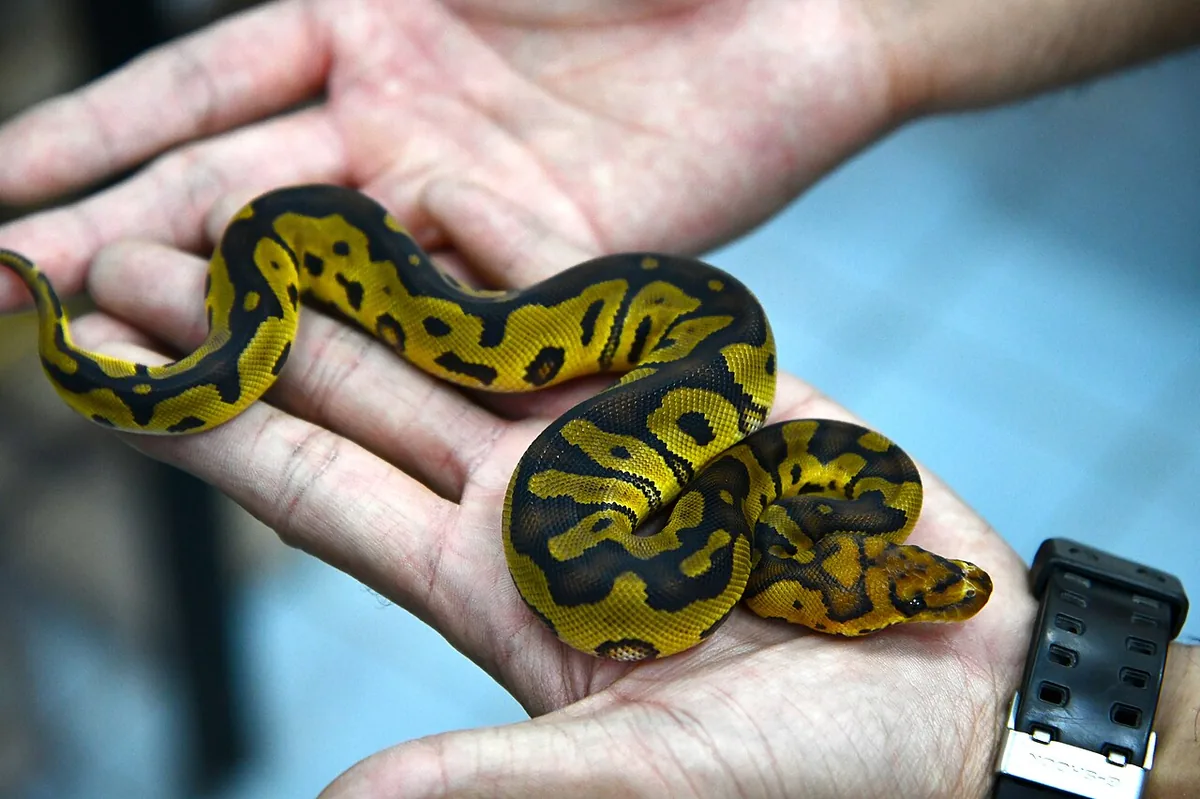
Ball pythons (Python regius) work well for keepers who want a docile, manageably-sized snake that doesn't need daily attention and tolerates regular handling. They're nocturnal-to-crepuscular, generally calm, and rarely bite outside of feeding mistakes. The catch: they live 20-30+ years and are unforgiving of long-term husbandry problems. They are not impulse purchases.
They're not ideal for keepers who want an active display animal, ball pythons spend most of their time hidden, which is what they should be doing. They're also not ideal for households that travel often without arranging proper temperature and humidity monitoring during absences.
How big do ball pythons get?
Adult female ball pythons average 4-5 feet in length and 1,500-2,500 grams in weight. Adult males average 3-4 feet and 700-1,500 grams. Females are noticeably larger than males. Exceptional females can exceed 5 feet but this is unusual. Growth is most rapid during the first 2-3 years; after that, weight gain continues slowly throughout life.
The largest documented wild-caught ball python was around 6 feet, but captive-bred animals on commercial rodent diets rarely reach this size. Anyone selling you a "giant" ball python that needs an enormous enclosure is selling a misconception.
How long do ball pythons live?
Captive ball pythons routinely live 20-30 years with proper care. The documented longevity record exceeds 45 years (a female at the Saint Louis Zoo). For most people buying a ball python, this is a longer commitment than a dog. If you're 20 years old buying a hatchling, plan on having that animal into your 40s or 50s.
What size enclosure does a ball python need?
For adult ball pythons, the minimum recommended enclosure is 4 feet long by 2 feet wide by 2 feet tall (approximately 120 × 60 × 60 cm), a "4x2x2." Larger is fine and increasingly recommended by herpetologists; the older guidance that snakes get stressed in oversized enclosures has been largely debunked when sufficient hide cover and visual barriers are provided.
Hatchlings can start in smaller enclosures (around 20 gallons) but most keepers find it easier to set up the adult enclosure correctly from the start and use additional clutter (hides, plants, branches) to make a young snake feel secure in the larger space. PVC enclosures, sealed wood, or other front-opening designs work better than top-opening glass aquariums because they hold humidity and reduce stress.
What temperature and humidity do ball pythons need?
Ball pythons need a clear thermal gradient end-to-end:
- Warm side basking surface: 88-92°F (31-33°C), measured at the surface where the snake actually contacts heat, not air temperature six inches above.
- Warm side ambient air: 82-85°F (28-29°C)
- Cool side: 75-80°F (24-27°C). Never let the cool side drop below 72°F (22°C) for extended periods.
- Nighttime: a modest drop is fine; never below 70°F (21°C).
Use radiant heat panels, ceramic heat emitters, or deep-heat projectors on thermostats. Heat rocks are unsafe and cause burns. Heating pads attached to the bottom of glass tanks can work for hatchlings but struggle to heat ambient air in larger enclosures.
Humidity: 55-65% baseline, raised to 70-80% during shed. Low humidity is the #1 husbandry issue for captive ball pythons. Symptoms of chronic low humidity include incomplete sheds (especially around the eyes and tail tip), dry skin, and predisposition to respiratory infection. Use a hygrometer and adjust by misting, using a humid hide (a plastic container with damp sphagnum moss inside), increasing water bowl size, or partially covering screen tops.
Do ball pythons need UVB lighting?
This is an area where current research is shifting. Older guidance said ball pythons don't need UVB because they're nocturnal. Recent work suggests they do benefit from low-output UVB. Ferguson Zone 1 to 2 range, comparable to the dappled forest-floor light their wild environment provides. UVB helps with vitamin D3 metabolism and may improve overall vigor.
If you choose to provide UVB, use a tube-style bulb (T5 or T8) at the appropriate distance per the bulb manufacturer's chart, typically 12-18 inches from where the snake basks. Replace the bulb every 6-12 months even if it still emits visible light; UVB output declines well before the visible spectrum does.
What and how often do ball pythons eat?
Ball pythons eat appropriately-sized rodents. The "appropriately sized" part matters: prey should be no thicker than the widest part of the snake's body. For most adult ball pythons, that's a small-to-medium adult rat. Hatchlings start on rat fuzzies or small mice and graduate up.
Feeding schedule:
- Hatchlings (under 200g): one appropriately-sized fuzzy or small mouse every 5-7 days
- Juveniles (200-500g): one small rat or appropriate prey every 7-10 days
- Sub-adults (500-1000g): one medium rat every 10-14 days
- Adults (1000g+): one appropriately-sized rat every 10-14 days; some keepers extend to every 3-4 weeks for inactive adults
Always feed frozen-thawed rodents (never live, except in rare cases of feeding-strike refusal of frozen-thawed, and even then, supervised closely). Live rodents can injure or kill snakes during feeding strikes. Thaw rodents fully and warm to body temperature with hot water just before offering.
Ball pythons commonly go off-feed for weeks or months, especially adult males during breeding season (typically winter). A snake refusing food is rarely an emergency, a snake refusing food AND losing weight is. Track weight monthly so you have data, not anxiety.
How do you handle a ball python?
Ball pythons generally tolerate handling well, but a few rules apply:
- Don't handle after feeding for at least 48 hours. Handling on a full stomach can cause regurgitation, which is stressful and physically damaging.
- Don't handle during shed. Shedding snakes have reduced vision and are more defensive. Wait until the shed completes.
- Support the body: don't grab by the head or tail. Snakes need to feel that their full body is supported.
- Limit sessions to 15-30 minutes, especially with younger animals. Snakes thermoregulate ectothermically; long handling sessions in cooler rooms drop their body temperature.
- Wash hands before and after. Before, to remove any food smells that might trigger a feeding strike. After, for hygiene, reptiles can carry Salmonella, though risk is low with basic hygiene.
Common ball python health problems
- Respiratory infection: usually caused by chronic low humidity, low temperatures, or both. Signs: open-mouth breathing, mucus around the mouth or nostrils, audible respiration. Requires veterinary treatment. Often fatal if untreated.
- Incomplete sheds (dysecdysis): incomplete skin sheds, especially around the eye caps and tail tip. Cause is almost always low humidity. Stuck eye caps can damage the eye if left for multiple shed cycles.
- Scale rot: discolored, blistered, or pitted ventral scales caused by chronic excessive moisture (the opposite humidity problem). Wet substrate is the usual culprit.
- Mites: small black or red dots in the snake's enclosure, around the eyes, or under scales. Treat with appropriate products (Reptile Relief, Provent-a-Mite per label directions) and address the source.
- Inclusion Body Disease (IBD): a serious viral infection of pythons and boas. Always quarantine new acquisitions for 90+ days. If a new snake develops neurological signs (star-gazing, regurgitation, paralysis), see a reptile vet immediately.
For all health concerns, consult an exotic-animal veterinarian. ARAV's vet finder is the best resource.
Common mistakes ball python owners make
This is where most ball python welfare problems originate. The species is forgiving enough that mistakes don't kill quickly, but they do cause chronic suffering.
- Running the humidity too low. The single most common problem. Owners follow a generic "50-60% humidity" guideline that's fine for some snakes but too dry for ball pythons. Aim for 55-65% baseline and raise during shed.
- Using stick-on dial thermometers and hygrometers. These are wildly inaccurate. Use digital thermometers with probes; ideally an infrared temp gun for surface temperatures and a hygrometer with a probe sensor for humidity.
- Feeding too often. Pet store advice often says "feed once a week forever." Adult ball pythons fed weekly become obese, visibly fat bodies, fat pads behind the head, and predisposition to fatty liver disease. Adjust feeding frequency to body condition.
- Treating food refusal as an emergency. Ball pythons skip meals routinely, especially adult males in winter. Track weight; if the snake is stable, the snake is fine. If weight drops more than 10% over a few months, see a vet.
- Tank too small or too cluttered with no thermal gradient. A 20-gallon tank for an adult ball python cannot maintain a proper temperature gradient. Upgrade to a 4x2x2 or larger.
- Heat rocks. Don't use them. They burn snakes. Use radiant heat panels, ceramic heat emitters, or deep heat projectors on thermostats.
- Aspen bedding maintained too dry, or coco fiber maintained too wet. Match substrate moisture to species. Cypress mulch or coco fiber kept lightly damp on one end works well; bone-dry substrate everywhere causes shed problems.
- Skipping quarantine for new arrivals. 90+ days separated from existing collection, ideally in a different room, with separate husbandry equipment. Inclusion Body Disease and mites are devastating when introduced to an established collection.
Where to buy a ball python responsibly
Buy from reputable breeders or rescue. Avoid big-box pet stores, animals there are often kept in poor conditions and may arrive with established health problems. Marketplaces like MorphMarket let you research the breeder before purchase. Local reptile expos can be good if you can verify the breeder's setup.
Adopt from rescue when possible. Surrendered ball pythons are common and many are healthy adults whose owners weren't ready for the long-term commitment. State and regional reptile rescues are findable through Petfinder and local exotic vet referrals.
Related guides
- Corn snake care, often a better first snake than a ball python
- Hognose snake care, smaller alternative with more personality
- All snake guides
Frequently asked questions
How often should I handle my ball python?
Two to three times per week, in sessions of 15-30 minutes, is reasonable for an established, calm adult. Hatchlings need a 1-2 week settling-in period after acquisition with minimal handling, then gradual habituation. Avoid handling for at least 48 hours after feeding and during active shed.
Do ball pythons bite?
Rarely. When they do, it's usually a feeding-response strike (mistaking your hand for prey, especially if you smell like rodents) or a defensive bite from a stressed, unhabituated animal. Ball python bites are not medically serious, they have small teeth and are non-venomous. Wash with soap and water; bites heal in days.
My ball python isn't eating. Should I worry?
Probably not yet. Track weight monthly. If weight is stable, the snake is fine, ball pythons routinely fast for weeks or months, especially adult males during breeding season. If weight drops more than 10% over a couple of months, or if other symptoms appear (lethargy, mucus, abnormal posture), see an exotic vet.
Can I use a glass aquarium for a ball python?
You can, but PVC, sealed wood, or front-opening designs work better. Glass aquariums with screen tops lose humidity quickly and require constant misting to maintain target levels. Glass also lets the snake see in multiple directions, which can stress a shy species. If you start with glass, plan to upgrade.
Can I keep two ball pythons together?
No. Ball pythons are solitary and cohabitation causes chronic stress, food competition, the inability to track individual feeding and health, and serious disease transmission risk. The only acceptable cohabitation is brief, supervised, controlled breeding pairings.