Red-Eared Slider Enclosure and Habitat
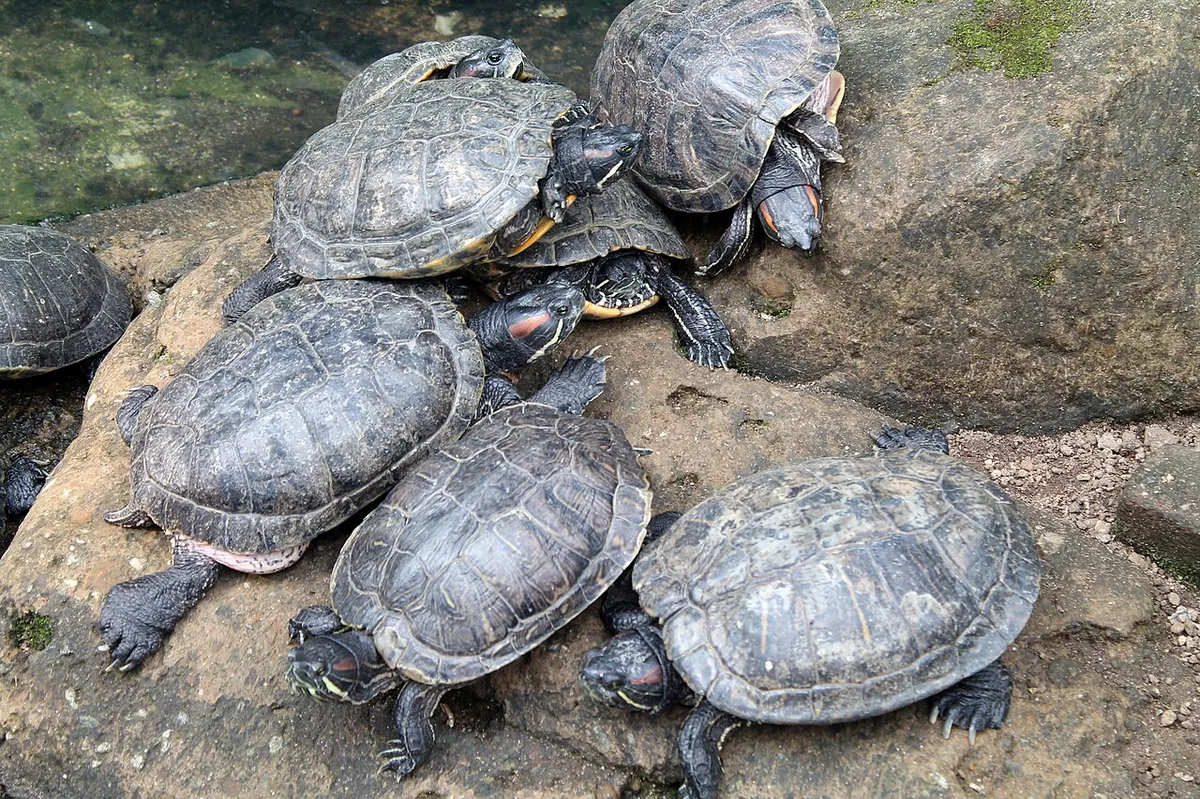
Slider tank sizing is unusual in having a published rule rather than a fixed figure: roughly 10 gallons of water per inch of shell length. That scales, which is the point, because a coin-sized hatchling becomes a turtle that can exceed 10 inches of shell.
What published sources give
| Figure | Size | Notes |
|---|---|---|
| The common rule | ~10 gallons of water per inch of shell length | Widely published sizing method for this species |
| Worked examples | 4 in juvenile ~40 gal · 8 in adult ~80 gal | Directly from the rule |
| Longer-term target seen in sources | Closer to 15 gallons per inch | Described as a roomier target rather than a minimum |
| Adult females | Can exceed 10 in shell | Females grow considerably larger than males |
Checked September 20, 2026. Where sources differ the range is shown rather than averaged. These are the figures published as minimums; none of them is a maximum.
What changes as they grow
Hatchling and juvenile
The rule scales with the animal, which is its advantage. A four-inch juvenile lands around 40 gallons. The mistake is treating the first tank as the last one, because this species keeps growing for years.
Adult
An eight-inch turtle reaches roughly 80 gallons on the standard rule, and adult females commonly exceed ten inches of shell. Plan for the female outcome, since sexing young sliders is unreliable.
Enclosure mistakes specific to this species
Buying the tank for the hatchling
A hatchling slider is the size of a coin and is often sold with a small kit. The adult needs a volume most people do not anticipate. This mismatch is a major reason sliders are among the most commonly surrendered and released reptiles.
Under-filtering
Aquatic turtles are messy, and filtration sized for fish is usually inadequate. Poor water quality drives shell and skin infections, and it is easier to over-filter than to keep up with water changes.
No dry basking area, or one that never dries
Sliders must be able to leave the water and dry off completely under heat and UVB. A basking platform that stays damp defeats the purpose and contributes to shell problems.
UVB through glass or a closed lid
Same failure as with lizards: glass filters UVB out, and bulbs lose output over months. Without usable UVB, calcium in the diet cannot be used, whatever the turtle eats.
Enclosure hazards that apply to almost every setup
Five hazards come up across nearly every species on this site: contact burns from unguarded heat, UVB that never reaches the animal, cutting ventilation to hold humidity, unsecured decor, and trusting a bulb's wattage instead of a thermometer. They are set out in full, with sources, on our enclosure hazards page, which is worth reading once against any setup including one that looks finished.
Signs the enclosure is wrong
Animals tell you about their housing through behaviour before they tell you through illness. None of these is a diagnosis; each is a reason to look at the enclosure and, where noted, to call a vet.
| What you see | What it can mean |
|---|---|
| Shell that is soft, pitted, or has raised pyramided scutes | Husbandry problem spanning diet, UVB and water quality. Veterinary attention. |
| Swollen or closed eyelids | Commonly vitamin A deficiency, but infections look similar. Needs diagnosis. |
| Constant basking, or constant refusal to bask | Both directions are worth investigating: temperature, lighting or illness. |
| Cloudy or smelly water between changes | Filtration is undersized for the animal, which will show up in the turtle before long. |
Common questions
How big a tank does a red-eared slider need?
The commonly published rule is around 10 gallons of water per inch of shell length. That puts a 4-inch juvenile near 40 gallons and an 8-inch adult near 80. Some sources suggest a roomier longer-term target closer to 15 gallons per inch.
How big do red-eared sliders get?
Adult females commonly exceed 10 inches of shell and males stay smaller. Because sexing young sliders is unreliable, the safe approach is to plan the enclosure around the female outcome.
Do red-eared sliders need a basking area?
Yes, and it must dry completely. They need to be able to leave the water entirely and dry off under heat and UVB. A platform that stays damp does not serve the purpose and contributes to shell problems.
Is a 20-gallon tank enough for a red-eared slider?
Only for a very small hatchling, and briefly. On the 10-gallons-per-inch rule a 20-gallon tank suits a turtle of about two inches. Sliders grow steadily for years, so the first tank should be treated as temporary from the outset.