← Eastern Box Turtle care guide
Eastern Box Turtle Enclosure and Habitat
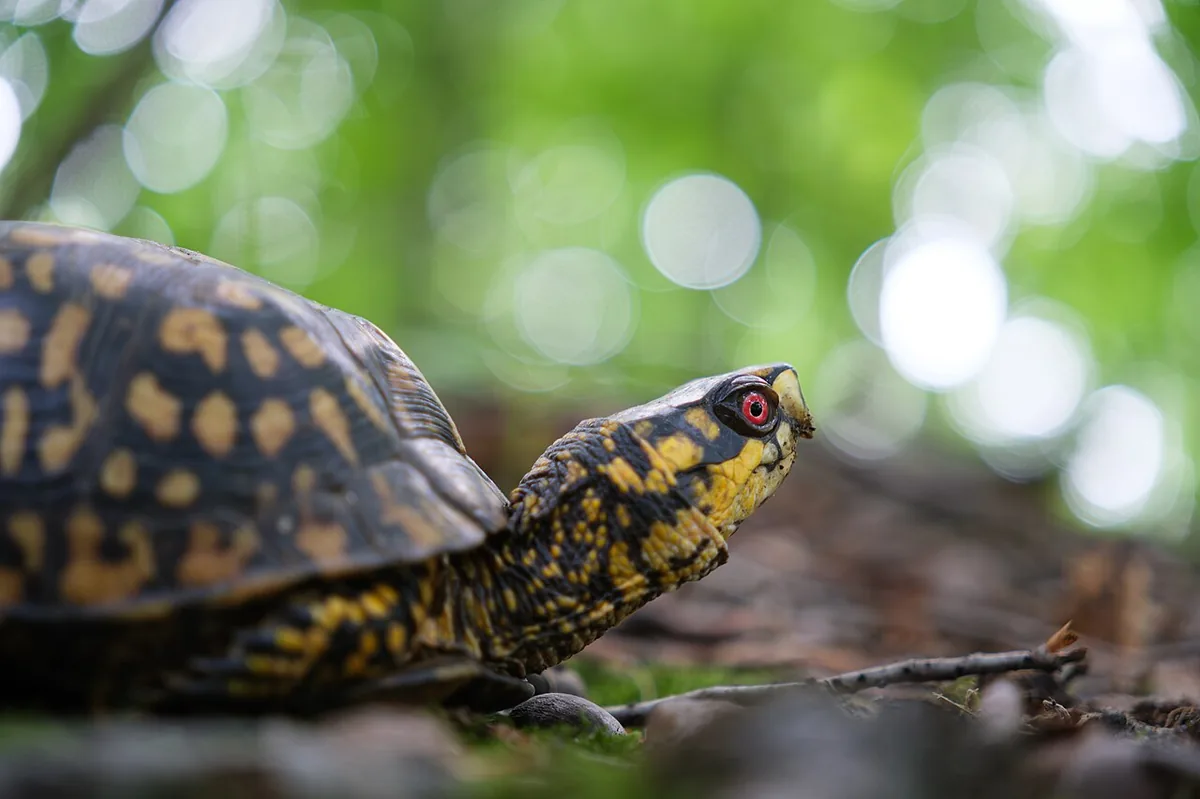
Box turtles sit awkwardly between the two halves of this group. They are terrestrial like a tortoise but need considerably more humidity and a water area, and published enclosure figures reflect a genuine animal rather than either template.
What published sources give
| Figure | Size | Notes |
|---|---|---|
| Indoor minimum, one adult | 4 x 2 ft | 6 x 3 ft described as better |
| Outdoor minimum, one adult | 4 x 4 ft | Commonly published figure |
| Water | Shallow water area to soak in | Not an aquatic turtle, but not dry either |
Checked September 20, 2026. Where sources differ the range is shown rather than averaged. These are the figures published as minimums; none of them is a maximum.
What changes as they grow
Hatchling and juvenile
Small, and very good at hiding. Humidity and cover matter more than floor area at this stage.
Adult
4 by 2 feet indoors as a published minimum with 6 by 3 described as better, and 4 by 4 feet outdoors. Outdoor keeping suits them well in appropriate climates.
Enclosure mistakes specific to this species
A boundary that is not sunk into the ground
Tortoises dig. A fence that starts at ground level is an invitation, and the animal has all day. Sinking the barrier is standard advice for outdoor pens.
Housing them like a tortoise
Box turtles need noticeably more humidity than Mediterranean tortoises and a shallow water area to soak in. A dry tortoise table is the wrong environment even though the animal looks like it belongs on one.
No shallow water to soak in
They soak regularly, and it supports hydration and shedding. The dish needs to be shallow enough to leave easily, since box turtles are not swimmers.
UVB mounted outside glass, or left in past its life
Glass filters UVB out, and bulbs lose output within 6 to 12 months while still looking lit. In shelled species this shows up as soft shell and metabolic bone disease, which is slow to appear and hard to reverse.
Enclosure hazards that apply to almost every setup
Five hazards come up across nearly every species on this site: contact burns from unguarded heat, UVB that never reaches the animal, cutting ventilation to hold humidity, unsecured decor, and trusting a bulb's wattage instead of a thermometer. They are set out in full, with sources, on our enclosure hazards page, which is worth reading once against any setup including one that looks finished.
Signs the enclosure is wrong
Animals tell you about their housing through behaviour before they tell you through illness. None of these is a diagnosis; each is a reason to look at the enclosure and, where noted, to call a vet.
| What you see | What it can mean |
|---|---|
| Swollen or closed eyelids | Commonly vitamin A deficiency in this species. Needs diagnosis, and the diet corrected. |
| Persistent hiding with no feeding | Check humidity, temperature and cover before assuming illness. |
| Dry, flaking skin or poor shed | Humidity too low. |
| Soft shell | Metabolic bone disease. Veterinary attention. |
Common questions
How big should a box turtle enclosure be?
Published guidance gives 4 by 2 feet as an indoor minimum for one adult, with 6 by 3 described as better. Outdoors, 4 by 4 feet is a commonly cited minimum for a single adult.
Can box turtles live in a tortoise enclosure?
Not straightforwardly. Box turtles need more humidity than Mediterranean tortoises and a shallow water area to soak in, so a dry tortoise table is the wrong environment even though the animal looks suited to one.
Do box turtles need water?
Yes, a shallow area they can soak in and leave easily. They are terrestrial rather than aquatic and are not strong swimmers, so depth matters as much as availability.