← Green Tree Python care guide
Green Tree Python Enclosure and Habitat
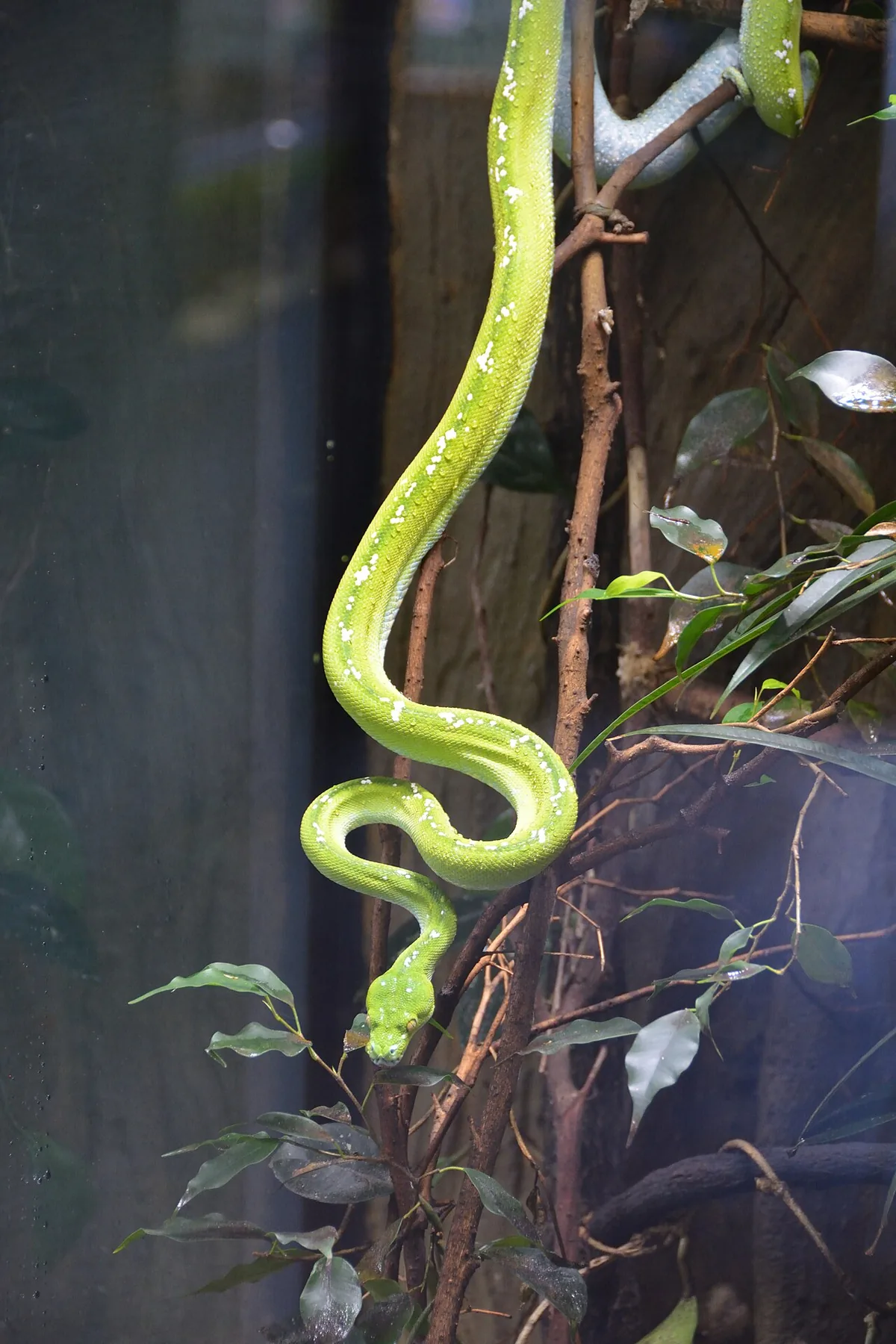
Green tree pythons spend nearly all their time coiled on a perch, so enclosure quality is mostly about height and perch placement rather than floor area. A tall enclosure with badly placed branches is a poor enclosure.
What published sources give
| Figure | Size | Notes |
|---|---|---|
| Orientation | Vertical; height over floor area | Arboreal ambush species |
| Perches | Horizontal branches at several heights | The primary furniture, not decoration |
| Humidity | High, and stable | Achieved by design and substrate, not by sealing |
Checked September 20, 2026. Where sources differ the range is shown rather than averaged. These are the figures published as minimums; none of them is a maximum.
What changes as they grow
Neonate and juvenile
Smaller, well-perched enclosures. Neonates are yellow or red and change to green over roughly the first year, which is normal and not a health sign.
Adult
Height and perch placement lead. The snake should be able to adopt its resting coil on a branch at more than one temperature.
Enclosure mistakes specific to this species
Any heat source without a thermostat
Belly heat is the classic cause of thermal burns in snakes, because a snake coils against warmth and does not move away from it. Every mat, cable and emitter on a thermostat with the probe where the animal actually contacts the heat.
Perches at one height only
An arboreal ambush snake thermoregulates by choosing a perch. With branches at a single level there is no gradient to choose from, however good the enclosure's temperatures look on a thermometer.
Sealing the enclosure to hold humidity
Green tree pythons need high humidity and the temptation is to close off ventilation. Merck's husbandry guidance warns this frequently causes skin and respiratory disease. Use substrate, misting and enclosure design instead.
Unguarded overhead heat
An arboreal snake climbs toward the heat source. Burn guidance singles out arboreal species for exactly this reason: any bulb or emitter needs a guard the snake cannot reach around.
Enclosure hazards that apply to almost every setup
Five hazards come up across nearly every species on this site: contact burns from unguarded heat, UVB that never reaches the animal, cutting ventilation to hold humidity, unsecured decor, and trusting a bulb's wattage instead of a thermometer. They are set out in full, with sources, on our enclosure hazards page, which is worth reading once against any setup including one that looks finished.
Signs the enclosure is wrong
Animals tell you about their housing through behaviour before they tell you through illness. None of these is a diagnosis; each is a reason to look at the enclosure and, where noted, to call a vet.
| What you see | What it can mean |
|---|---|
| Resting on the floor rather than a perch | Worth investigating: perch placement, temperature, or illness. |
| Laboured or open-mouth breathing | Respiratory disease, often humidity managed by cutting ventilation. Veterinary attention. |
| Burns along the dorsal surface | Overhead heat reached from a perch. Veterinary attention. |
| Persistent stuck shed | Usually humidity, but check it is stable rather than swinging. |
Common questions
What size enclosure does a green tree python need?
Guidance emphasises vertical space and perch placement rather than a single figure. The enclosure needs enough height for horizontal branches at several levels, so the snake can choose a perch at different temperatures.
How should green tree python perches be arranged?
Horizontal branches at several heights, positioned so the snake can adopt its resting coil at more than one temperature. Perches are the primary furniture for this species, not decoration.
Why is my green tree python on the floor?
In an arboreal ambush species this is worth investigating. Common causes are perches that are poorly placed or the wrong diameter, temperatures that are wrong at perch height, or illness.