Emerald Tree Boa Care Guide
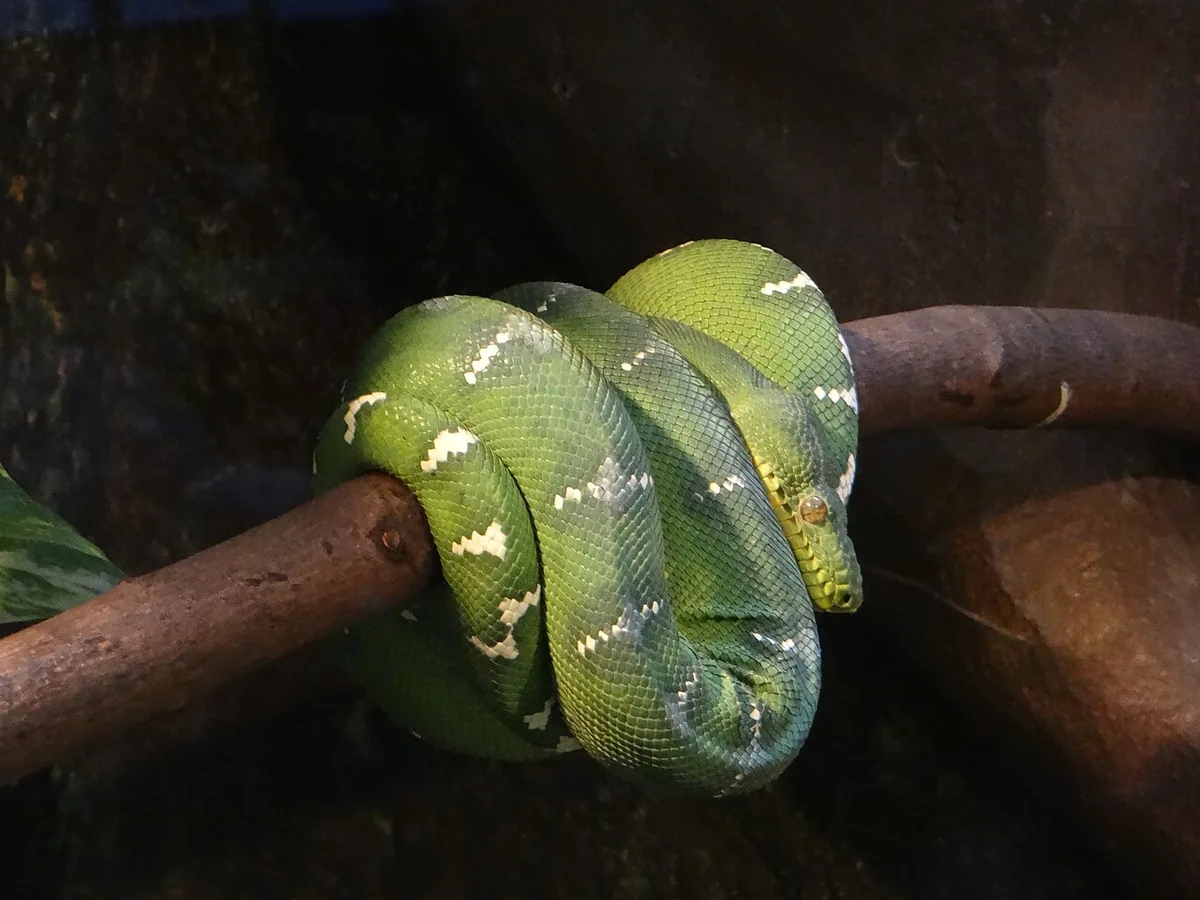
One of the most striking snakes kept in captivity and one of the least forgiving. Dehydration-prone, humidity-sensitive, and slow to metabolize food. A display animal for experienced keepers only.
Emerald Tree Boa at a glance
| Adult size | 4-9 ft (~6 ft typical) |
| Lifespan | 20+ years |
| Enclosure | 36 x 36 x 48 in minimum, vertically oriented |
| Temperature | Basking 88-93°F · ambient ~84°F · night ~78°F |
| Humidity | 70-90%, held consistently |
| UVB | Not required; low-level increasingly used |
| Diet | Small-to-medium rat every 2-4 weeks by sex |
| Handling | Minimal. Defensive, with long teeth |
| Experience | Advanced only |
What most emerald tree boa care sheets get wrong
These are the errors that show up most often in secondary care sheets and forum advice. Each one is a real welfare issue, not a preference.
The problem is not high humidity, it is unstable humidity.
Keepers often read "70 to 90 percent" and chase the top of the range with heavy misting, which swings the enclosure between saturated and dry. Emerald tree boas tolerate that poorly and respond with respiratory infections. A stable 75 percent with good ventilation is far better husbandry than a cycle between 95 and 50.
They need far less food than a similarly sized python.
Emeralds have a notably slow metabolism. Females do well on a small-to-medium rat roughly every two weeks and males every four. Feeding this species on a ball python schedule produces obesity, regurgitation, and long-term organ damage. Underfeeding is rarely the presenting problem in captivity.
Green does not mean adult, and adult does not mean tame.
Neonates are typically red or orange and change to green over roughly the first year, which surprises new buyers. Separately, this species does not habituate to handling the way a carpet python does. A calm emerald is an emerald being left alone.
Why keep a emerald tree boa
- Visually one of the most remarkable snakes in the world
- The coiled saddle posture on a branch is a genuine display feature
- Long-lived, and a well-kept adult is a 20-year companion animal
- Fully arboreal, so a tall planted enclosure is used properly
Why you might not want one
- Dehydrates easily and punishes inconsistent humidity with respiratory disease
- Defensive by nature, with proportionally very long teeth
- Slow metabolism means overfeeding is easy and damaging
- Not a first, second, or third snake. Advanced husbandry only
Common questions
Are emerald tree boas good for beginners?
No. Their humidity requirements are narrow and unforgiving, they dehydrate easily, they are defensive with long teeth, and they need a tall custom enclosure. They are an advanced species, and most experienced keepers recommend several years with more forgiving arboreal snakes first.
What humidity do emerald tree boas need?
Between 70 and 90 percent, measured with a digital probe hygrometer in the middle of the enclosure. Consistency matters more than hitting the top of the range. Large swings between saturated and dry are a common cause of respiratory infection in this species.
How often should you feed an emerald tree boa?
Females typically take a small-to-medium rat every two weeks and males every four weeks. Their metabolism is slow, and overfeeding is a far more common mistake than underfeeding. Adjust based on body condition rather than a fixed calendar.
How big do emerald tree boas get?
Four to nine feet, with about six feet being typical for a captive adult. Despite the length they are a relatively heavy-bodied arboreal snake, and enclosure height matters more than floor space because they spend nearly all their time on branches.
Why is my baby emerald tree boa red?
That is normal. Neonates are usually born red, orange, or brick colored and transition to the adult green over roughly the first year of life. The change is gradual and is not a sign of illness or of a mislabeled animal.
What size enclosure does an emerald tree boa need?
At minimum around 3 feet wide, 3 feet deep, and 4 feet tall, with several sturdy horizontal branches at varying heights. A solid-top enclosure with controlled ventilation is usually necessary to hold humidity stable, especially in a dry climate.