Rankin's Dragon Care Guide
Is a Rankin's dragon right for you?
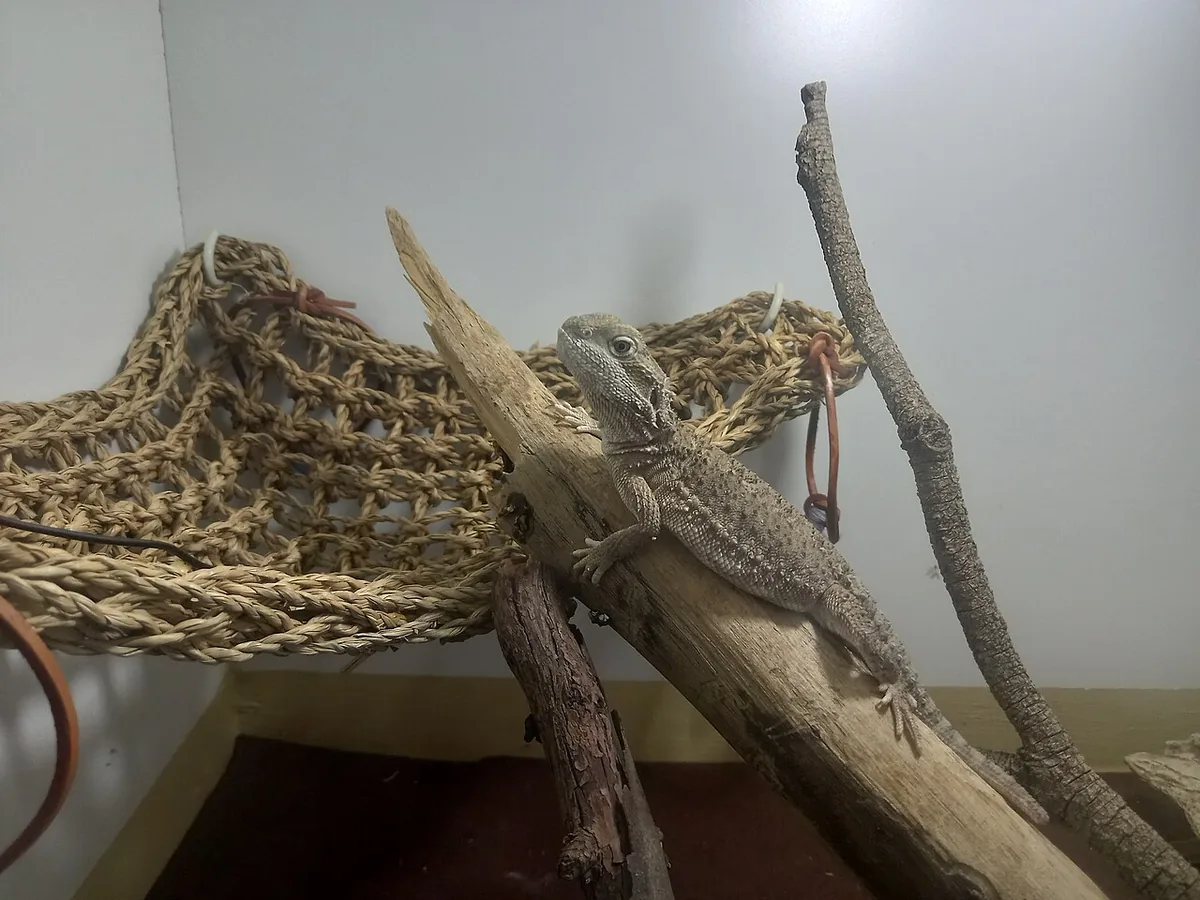
They are a strong pick for someone who loves bearded dragon temperament but wants a smaller animal in a smaller enclosure. Rankin's are calm, active, day-loving little lizards that handle well and take the same equipment as a beardie in a more compact footprint. The main catches are availability, since they are less common than beardies, and the hybrid issue covered below.
Max kept bearded dragons before his current Uromastyx, and his read is that a true Rankin's is a genuinely good beginner lizard, provided you go in knowing it needs the same UVB and heat discipline as its bigger cousin. Smaller does not mean lower-effort on lighting.
Rankin's dragon vs bearded dragon: what is the difference?
They are different species in the same genus (Pogona). Rankin's (P. henrylawsoni) is the dwarf of the group, with a blunter snout and a smaller beard than the central bearded dragon (P. vitticeps). Care is similar in kind but scaled down in size, and Rankin's tolerate group housing better. Here is the side by side:
| Trait | Rankin's dragon | Bearded dragon |
|---|---|---|
| Adult length | ~10-12 in (under 30 cm) | ~18-24 in |
| Adult weight | ~60-100 g (keeper-reported) | ~350-500 g |
| Minimum enclosure | 36 × 18 × 18 in | 48 × 24 × 24 in |
| Basking surface | 100-108°F | 100-110°F |
| UVB | T5 HO 10-12% | T5 HO 10-12% |
| Group housing | Females often tolerate it | Generally solitary |
| Availability | Less common, fewer breeders | Everywhere |
Group-housing tolerance is a keeper-community observation rather than a veterinary standard, and males should never be housed together. Solo housing is always the safest default.
How big do Rankin's dragons get?
Adults reach about 10-12 inches (under 30 cm) in total length including the tail, which makes them the smallest species in the genus Pogona. Reported weights sit around 60-100 grams, though those gram figures come from keeper care sheets rather than a veterinary reference. A well-fed female can push the top of the range. For comparison, a central bearded dragon runs 18-24 inches.
How long do Rankin's dragons live?
With correct heat, UVB, diet, and supplementation, Rankin's dragons commonly live 8-12 years or more, and some sources report up to 15. Poor husbandry, meaning weak UVB, cool temperatures, or a calcium-short diet, shortens that considerably by causing metabolic bone disease. There is no formal longevity study for this species, so treat the higher numbers as experienced-keeper reports.
What size tank does a Rankin's dragon need?
A single adult needs a minimum of 36 × 18 × 18 inches, which is roughly a 40-gallon footprint. Bigger is better, and a 48 × 24 × 24 inch enclosure is preferred, and necessary if you keep a small group of three or four. Do not drop below 36 × 18 × 18. Floor space, not height, is what matters for a ground-dwelling basker.
A front-opening wood or PVC vivarium holds heat better and stresses the animal less than a top-opening glass tank. For substrate, use tile or slate, or a firm, compactable sand and organic-soil mix. Avoid loose calcium sand and walnut shell, which carry impaction risk.
Heating and basking temperatures
Basking numbers here come with real spread between sources, so treat them as a target range rather than one exact figure.
- Basking surface: about 100-108°F (38-42°C), measured at the surface with a probe or infrared gun. Because the body is smaller, the lower end of the beardie range is appropriate. (Individual care sheets range from roughly 95 to 115°F.)
- Warm ambient: around 90-95°F.
- Cool side: about 78-85°F, giving a true gradient.
- Night: a drop to 65-72°F is fine. No night heat is needed unless the room falls below about 60°F.
- Control: run the basking lamp on a dimming thermostat and verify with two thermometers plus a surface reading. Never trust the bulb's rated wattage.
What UVB does a Rankin's dragon need?
The same desert-grade UVB a bearded dragon needs, because Rankin's are open-habitat, full-sun baskers. Use a high-output linear T5 HO tube rated 10.0 or 10-12% (Zoo Med ReptiSun T5 HO 10.0 or Arcadia Desert 12% are the named standards). Span about two-thirds of the enclosure over the basking zone, mount it roughly 12 inches above the basking surface if unscreened, and never filter UVB through glass or acrylic. Replace the tube every 6-12 months as output fades.
What do Rankin's dragons eat?
They are omnivores, and the diet follows the same age curve as a bearded dragon: insect-heavy as a hatchling, plant-heavy as an adult.
- Hatchling (under 3 months): about 80% insects, 20% greens.
- Juvenile (3-7 months): roughly 60-70% insects.
- Sub-adult: around 40-50% insects.
- Adult: about 20-30% insects, 70-80% greens.
Good insects: crickets, dubia roaches, black soldier fly larvae, and silkworms. Feed nothing wider than the space between the eyes to avoid impaction, and skip mealworms as a staple. Good greens: collard, turnip, mustard, and dandelion greens, endive, escarole, and arugula. Avoid spinach and beet greens as staples, since their oxalates bind calcium. Dust insects with calcium (plain calcium if UVB is strong, calcium with D3 a few times a week as insurance) and add a multivitamin about once a week. Aside from smaller prey and portions, this is bearded dragon feeding.
Common health problems
- Metabolic bone disease (MBD): the most common bone disease in reptile practice. Caused by too little UVB, calcium, or vitamin D3, or by cool temperatures. Signs include a soft or swollen jaw, bent limbs, tremors, and lethargy. Treatable if caught while the animal is still eating.
- Impaction: gut blockage from oversized or hard prey, loose sand, or cool temperatures that slow digestion. Signs: straining, no stool, bloating, lethargy.
- Respiratory infection: usually from cool temperatures plus high humidity or poor ventilation. Signs: open-mouth breathing, mucus, puffing, clicking. Needs a vet.
- Parasites: coccidia and pinworms among others, more common in wild-caught or crowded, dirty setups. Diagnosed by a fecal exam.
As with all Pogona, these are veterinary problems, not home-treatment problems. The disease mechanisms are documented at the genus level by the Merck Veterinary Manual and veterinary teaching hospitals.
The hybrid trap: is your Rankin's really a Rankin's?
This is the most useful thing a first-time buyer can know. Rankin's dragons are sometimes crossed with bearded dragons to produce hybrids nicknamed "vittikins." Animals sold as "Rankin's" or "dwarf bearded dragons," especially outside Australia, are frequently these hybrids rather than pure Pogona henrylawsoni. A hybrid can grow noticeably larger than a true 10-12 inch Rankin's, which upends your enclosure and cohabitation plans.
This is a breeder and hobby-community observation, not a peer-reviewed finding, so take it as buyer-beware rather than gospel. If a pure Rankin's matters to you, buy from a breeder who can document lineage. If you just want a small, docile dragon and do not mind a hybrid, that is a fine choice too, as long as you know what you are getting.
Common Rankin's dragon mistakes
- Buying a mislabeled hybrid. Unexpected adult size and unknown genetics follow from it. Ask for lineage.
- Weak or expired UVB, or UVB behind glass. The direct road to MBD. Use a T5 HO 10-12% and replace on schedule.
- A basking spot too cool. Below about 100°F, digestion and calcium metabolism both suffer.
- Oversized prey plus loose sand. A classic impaction combination. Feed small, use firm substrate for juveniles.
- Housing males together. They fight. Even among females, watch for bullying and separate at the first sign.
- Treating it like a full-size beardie. Adult-beardie portions and prey sizes on a smaller animal drive obesity and impaction. Right-size everything.
Related guides
- Bearded dragon care, the larger cousin and the animal Rankin's are compared to
- All lizard guides
- Bearded dragon UVB and metabolic bone disease, the same lighting lesson applies here
Frequently asked questions
Are Rankin's dragons the same as bearded dragons?
No. Rankin's dragons (Pogona henrylawsoni) and the common bearded dragon (Pogona vitticeps) are separate species in the same genus. Rankin's stay under about 12 inches, roughly half a beardie's length, with a blunter snout and a smaller beard. Both are docile, diurnal Australian omnivores, but Rankin's are smaller, less common in the trade, and tolerate group housing better.
How big do Rankin's dragons get?
Adults reach about 10 to 12 inches (under 30 cm) in total length including the tail, and commonly weigh around 60 to 100 grams. That makes them the smallest species in the genus Pogona and notably smaller than a central bearded dragon, which reaches 18 to 24 inches. Weight figures are keeper-reported rather than from a veterinary study.
What size tank does a Rankin's dragon need?
A single adult needs at least 36 by 18 by 18 inches, about a 40-gallon footprint. Bigger is better, and a 48 by 24 by 24 inch enclosure is preferred and required for a small group. A front-opening wood or PVC vivarium holds heat and reduces stress better than a glass tank. Floor space matters more than height for a ground-dwelling basker.
What basking temperature does a Rankin's dragon need?
Provide a basking surface of roughly 100 to 108°F (38 to 42°C), a warm-side ambient near 90 to 95°F, and a cool side around 78 to 85°F so the lizard can thermoregulate. Night temperatures can fall to 65 to 72°F. Control the heat lamp with a dimming thermostat and verify with a probe or infrared thermometer, never bulb wattage. Care-sheet sources vary from about 95 to 115°F.
Is my Rankin's dragon actually a hybrid?
Possibly. Rankin's crossed with bearded dragons produce vittikins hybrids, and animals sold as Rankin's or dwarf bearded dragons, particularly overseas, are often these crosses rather than pure Pogona henrylawsoni. A hybrid may grow larger than a true Rankin's. Buy from a breeder who documents lineage if purity matters to you. This is a breeder and hobby-community observation rather than a peer-reviewed fact.