Bearded Dragon Care Guide
Is a bearded dragon right for you?
Bearded dragons are excellent for keepers who want a diurnal, interactive lizard that tolerates handling and has reasonable space requirements. They're not low-maintenance, proper husbandry requires a substantial upfront equipment investment (good UVB and lighting alone runs $150-250) and daily attention to fresh food. They live 8-12 years.
They're not ideal for households unwilling to commit to high-output UVB (the cheap bulbs sold at pet stores cause metabolic bone disease) or to chopping fresh vegetables daily for the animal's life.
How big do bearded dragons get?
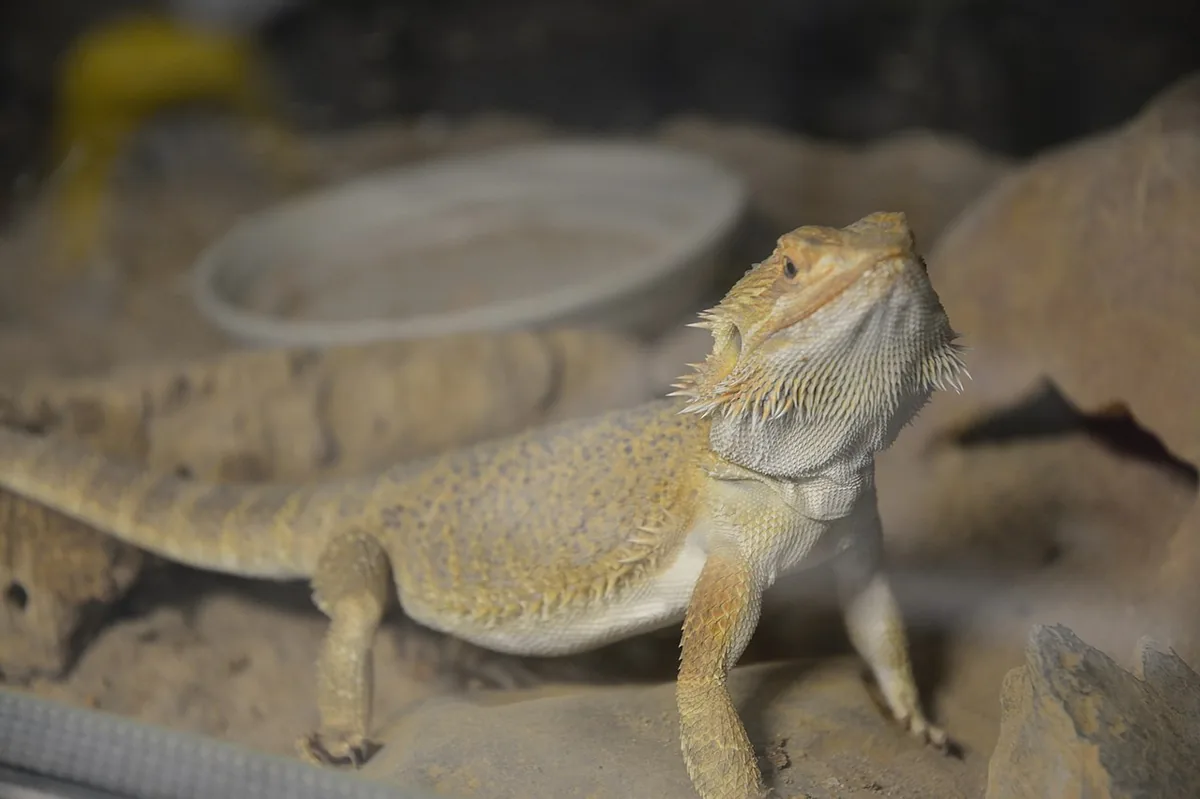
Adult bearded dragons average 18-24 inches in total length (about half of that is tail) and 350-500 grams in weight. Females are slightly smaller than males on average but the size difference is modest. Most beardies reach near-adult size within 12-18 months.
How long do bearded dragons live?
With proper UVB, appropriate diet, and adequate enclosure, captive bearded dragons live 8-12 years. The most common cause of premature death is metabolic bone disease from chronic UVB inadequacy, often paired with calcium-poor diet. Beardies kept in suboptimal conditions often survive 3-5 years with progressive welfare issues.
What size enclosure does a bearded dragon need?
Minimum adult enclosure: 4 ft long × 2 ft wide × 2 ft tall (120 × 60 × 60 cm). This is roughly a "120-gallon" footprint. Bigger is better, these are active, semi-arboreal desert lizards that benefit from climbing structures, basking surface variation, and substrate area for digging.
Front-opening PVC or sealed wood enclosures hold heat and humidity better than glass aquariums and reduce stress (top-opening enclosures put the keeper in a predator position above the animal). A 40-gallon "breeder" tank is sometimes sold as adult-sized; it is not.
UVB and lighting, where most owners go wrong
This is the most important section of any bearded dragon guide. Get this right and most other husbandry problems become recoverable. Get this wrong and you'll be treating metabolic bone disease.
- Bulb type: Linear T5 high-output (HO) UVB bulb. Specifically the Arcadia 12% Desert (also called T5 12%) or Zoo Med Reptisun 10.0 T5 HO. Compact / coil UVB bulbs are inadequate for bearded dragons.
- Length: Bulb should be approximately 2/3 to 3/4 the length of the enclosure. Spans most of the basking and ambient warm area.
- Mounting: Inside the enclosure or above a screen top. UVB does not pass through glass or solid plastic. A UVB bulb sitting on top of a glass aquarium with a glass lid is doing nothing.
- Distance from basking surface: Follow the bulb manufacturer's chart. Typically 12-18 inches for the T5 HO bulbs at the basking spot.
- Replacement: Every 6-12 months. UVB output degrades long before the bulb stops emitting visible light. A bulb that "looks fine" after 18 months is producing little usable UVB.
- Photoperiod: 12-14 hours daily. Off at night.
You also need a separate, bright, white basking light (a halogen flood lamp works well) over a basking platform. Bearded dragons need both visible light and UVB; one bulb does not replace the other.
Temperature gradients
- Basking surface: 100-110°F (38-43°C) measured at the surface where the lizard rests, not air temperature
- Ambient warm side: 85-90°F (29-32°C)
- Cool side: 75-80°F (24-27°C)
- Night: 65-75°F (18-24°C). No supplemental heat needed unless room temperature drops below 65°F.
Use a halogen flood basking lamp on a dimming thermostat. Avoid red/infrared "night" bulbs, reptiles can see red light and constant red lighting disrupts day-night cycles.
What do bearded dragons eat?
Bearded dragons are omnivores. Diet ratio shifts with age:
- Hatchlings (0-3 months): ~70% insects, ~30% greens. Fed insects 2-3 times daily, greens always available.
- Juveniles (3-12 months): ~50/50. Insects daily, greens always available.
- Sub-adults (12-18 months): ~30% insects, ~70% greens. Insects every other day.
- Adults (18+ months): ~20-30% insects, ~70-80% greens. Insects 2-3 times per week.
Good insects: Dubia roaches (best staple), black soldier fly larvae (calcium-rich), crickets, silkworms, hornworms (treats). Avoid as staples: mealworms (high chitin, low nutrition), waxworms (fattening).
Good greens (daily): Collard greens, mustard greens, turnip greens, dandelion greens, endive, escarole. Use sparingly: kale (goitrogenic in excess), spinach (oxalate binds calcium). Vegetables: bell pepper, butternut squash, summer squash, green beans (chopped small). Fruits: small amounts as treats only, berries, mango.
Supplementation: Dust insects with calcium powder (no D3) at most feedings. Add a multivitamin with D3 once weekly. Calcium-with-D3 powder should be limited if good UVB is in place; overusing D3 supplements while running strong UVB can cause hypercalcemia.
Handling
Bearded dragons generally tolerate handling well and many seem to enjoy it. Start handling sessions short (5-10 minutes) and increase as the animal habituates. Support the body, don't grab by the tail. Wash hands before and after for hygiene and to remove food smells.
Beardies "wave" (slow front-leg circle) as a submissive gesture, often when seeing larger animals or humans. "Head bobs" are typically dominance or breeding behavior. Gaping (open mouth) is thermoregulation, not aggression.
Common health problems
- Metabolic Bone Disease (MBD): The #1 health problem in captive bearded dragons. Caused by inadequate UVB and/or insufficient dietary calcium relative to phosphorus. Signs: jelly-like jaw, soft mandible, twitching limbs, kinked tail, weakness, broken bones from minor trauma. Often irreversible by the time it's diagnosed. Prevention is UVB and diet, there is no shortcut.
- Impaction: Gastrointestinal blockage from substrate ingestion (loose sand, walnut shell), oversized prey, or chronic dehydration. Signs: not pooping, lethargy, refusing food, swollen abdomen. Veterinary emergency.
- Atadenovirus: A serious viral infection of bearded dragons. Always quarantine new arrivals 90+ days. Signs in active disease: stunted growth, paralysis, neurological symptoms. Many beardies are asymptomatic carriers.
- Coccidiosis: Parasitic infection causing diarrhea and weight loss. Diagnosed with fecal sample. Treated by an exotic vet.
- Respiratory infection: Open-mouth breathing, mucus, lethargy. Usually caused by chronic low temperatures or poor ventilation. Requires vet treatment.
Common bearded dragon husbandry mistakes
- Coil UVB bulbs. Insufficient output for a desert basking species. The single biggest cause of metabolic bone disease.
- UVB filtered through glass or plexiglass. Mount the bulb inside the enclosure or above a screen mesh. Glass blocks UVB.
- Not replacing UVB bulbs on schedule. Output drops below useful levels by 12-18 months even when the bulb still emits visible light.
- Loose particulate substrate for hatchlings and juveniles. Sand, calci-sand, walnut shell, all cause impaction in young beardies. Use tile, paper, reptile carpet, or excavator clay packed flat for animals under 12 months.
- Too small an enclosure. Adult beardies in 40-gallon breeders or even smaller. They need a 4x2x2 minimum.
- Too many insects, not enough vegetables, for adults. Adult beardies on insect-heavy diets become obese and develop fatty liver disease.
- Feeding insects too big. Prey items should be no wider than the space between the dragon's eyes. Oversized prey causes impaction and spinal injury.
- Cohabitation. Bearded dragons are solitary and territorial. Two beardies in one enclosure result in chronic stress, food competition, fighting, and injury. The smaller one always loses.
- Inadequate calcium dusting. Most adult beardies need calcium powder on insects at most feedings.
- Bathing as primary hydration strategy. Beardies don't drink from baths reliably. Provide moisture through fresh vegetables and the occasional misting. Baths are fine but aren't a hydration solution.
Where to buy a bearded dragon responsibly
Reputable breeders or rescues are the best sources. Big-box pet stores often sell beardies that are already showing early signs of poor husbandry (twitchy limbs, soft jaw, stunted growth). Rescues frequently have healthy adults whose original owners couldn't keep up with proper UVB and diet, adopting one is often a great option.
Related guides
- Leopard gecko care, smaller alternative, simpler husbandry
- Blue-tongued skink care, another omnivore option
- All lizard guides
Frequently asked questions
Can I house two bearded dragons together?
No. Bearded dragons are solitary. Cohabiting causes chronic stress, food competition, fighting, and injury. The dominant dragon hogs the basking spot and food; the subordinate becomes stunted and stressed. The "they get along" story is the keeper missing subtle stress signals.
Does my bearded dragon need a humidity gauge?
Yes. Beardies are desert animals and need humidity in the 30-40% range. Excess humidity (over 50% chronically) causes respiratory issues. Use a digital hygrometer.
Why isn't my bearded dragon eating?
Brumation (winter slowdown) is normal in adults and can last weeks. Other causes: enclosure too cold, UVB inadequate, parasites, atadenovirus, impaction, stress from cohabitation or recent move. If the animal is also losing weight or showing other symptoms, see an exotic vet.