Fire Skink Care Guide
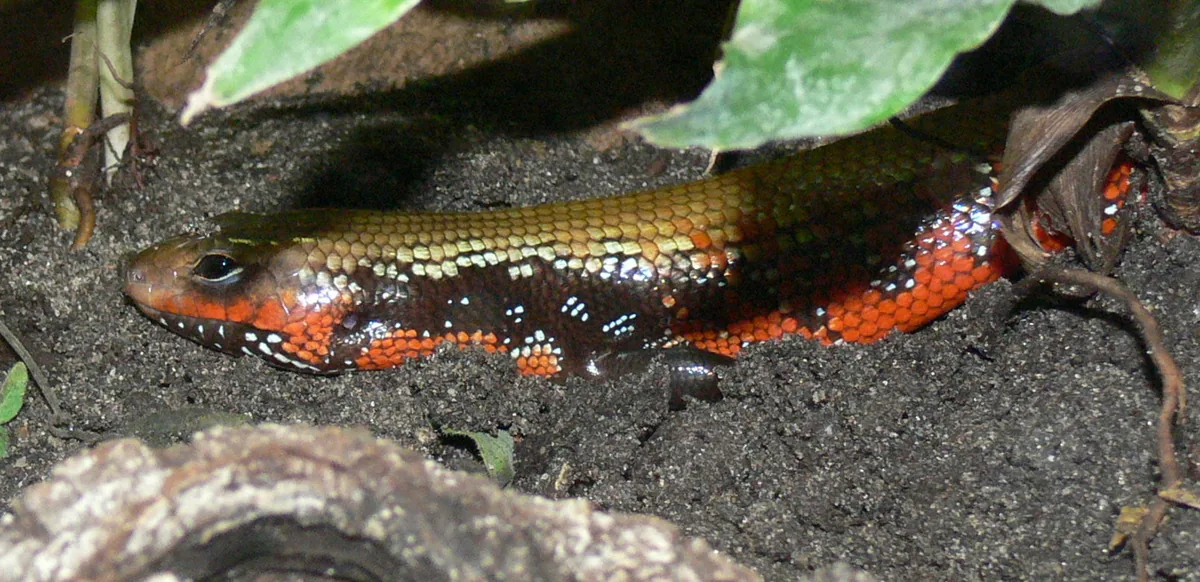
A West African forest-floor skink with red, black and gold flanks that few lizards match. The catch is behavioural: fire skinks are committed burrowers, and giving them the substrate depth they need means accepting that you will often not see them.
Fire Skink at a glance
| Adult size | 30-35 cm (12-14 in) |
| Lifespan | 15-20 years reported |
| Enclosure | 36 x 18 in floor space minimum; depth matters more than height |
| Substrate | Several inches of deep, moisture-retentive substrate |
| Temperature | Ambient 75-85°F with a basking area around 95°F |
| Humidity | 60-70% |
| UVB | Recommended |
| Diet | Insects: crickets, roaches, worms |
| Handling | Skittish; they are fast and prefer to bolt for cover |
| Experience | Beginner to intermediate |
What most fire skink care sheets get wrong
These are the errors that show up most often in secondary care sheets and forum advice. Each one is a real welfare issue, not a preference.
The better the setup, the less you see them.
Fire skinks are bought for their colour and are committed burrowers. Provide the several inches of moisture-retentive substrate they actually need and the animal will spend much of its time underneath it. Keepers who respond by reducing substrate depth to see the lizard more are trading the animal's welfare for their own viewing, and usually get a stressed skink that hides anyway.
Hiding is not a health problem here.
Because fire skinks are so visually striking, an owner who never sees theirs tends to assume something is wrong. Burrowing and hiding beneath substrate and leaf litter are normal behaviours for the species. Weigh the animal and check for feeding evidence rather than digging it out to look at it.
Check whether yours is wild-caught.
A substantial proportion of fire skinks in the trade are wild-collected, and those animals arrive stressed and carrying parasites. It affects early feeding and settling, and a faecal screen with an exotics vet in the first weeks is sensible rather than excessive.
Why keep a fire skink
- Genuinely spectacular colour: red, black, gold and white flanks
- Modest space requirements for the visual impact
- Hardy once humidity and substrate depth are right
- Interesting active foraging behaviour when they are out
- Long-lived for a small skink
Why you might not want one
- You will often not see them, and that is correct husbandry rather than a fault
- Skittish and fast; not a handling animal
- Deep moist substrate needs maintaining to avoid going stale
- Many available animals are wild-caught, with the parasite load that implies
Common questions
How big do fire skinks get?
Adults reach roughly 30 to 35 centimetres, or about 12 to 14 inches, including the tail. They are stocky and muscular for their length, and need floor space and substrate depth far more than they need height.
Why do I never see my fire skink?
Because burrowing is normal behaviour for the species. Fire skinks are forest-floor animals that spend much of their time beneath substrate and leaf litter. Providing the several inches of deep substrate they need makes them less visible, and that is correct husbandry rather than a problem to fix.
What do fire skinks eat?
Insects: crickets, dubia roaches, mealworms and earthworms, gut-loaded and dusted with calcium. They are active foragers with good appetites when they are out from under the substrate.
What humidity do fire skinks need?
Around 60 to 70 percent, maintained with regular misting and a moisture-retentive substrate. They come from West African forest floor habitat, so a dry enclosure causes shedding problems and general decline.
Are fire skinks good for beginners?
They are hardy and undemanding once the substrate and humidity are right, so yes in husbandry terms. The caveat is expectation: a beginner hoping for a visible, handleable lizard will be disappointed by an animal that spends much of its life buried.