What do fire skinks eat?
The short answer
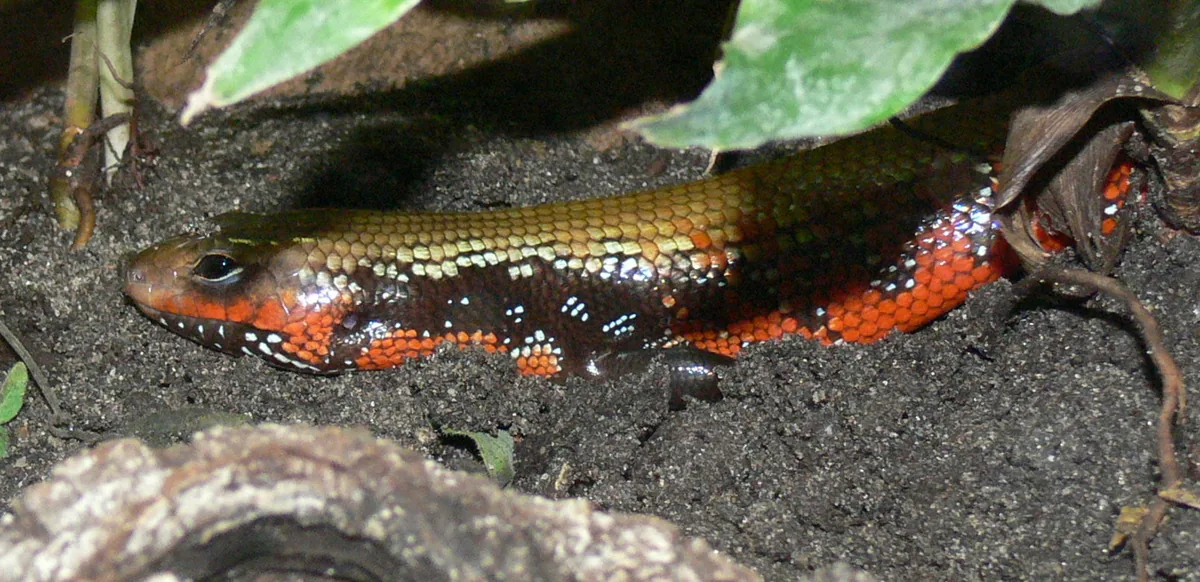
Fire skinks are insectivores with healthy appetites and an active, muscular foraging style. The practical problem is not what they eat but where they are when you offer it: they spend much of their time under several inches of substrate, so feeding routines that work for a visible basking lizard need adapting.
Feeding schedule by age
| Life stage | Diet balance | How often | Notes |
|---|---|---|---|
| Juvenile | Small insects | Daily | Growing |
| Adult | Insect rotation | Every 1-2 days | Good appetite when out |
| All ages | Bioactive clean-up crew | Continuous | Isopods provide background foraging |
Intervals and ratios here follow the sources listed at the foot of this page, checked September 20, 2026. Where those sources differ, the disagreement is set out in Where good sources disagree rather than averaged into a single number. Figures resting on keeper consensus rather than a published source are labelled as such where they appear.
What to feed
| Food | Role | Why |
|---|---|---|
| Dubia roaches | Staple | Good protein and ratio |
| Crickets | Staple | Active prey suits their hunting style |
| Black soldier fly larvae | Staple | Calcium-rich |
| Earthworms | Rotation | Well accepted |
| Isopods | Continuous | Ideal in a bioactive enclosure |
| Superworms | Occasional | Higher fat |
| Gut-loaded insects | Requirement | Feed the insects 24-48h before offering |
| Calcium dusting | Requirement | Insects are calcium-poor as bought |
What never to feed
Items in this table are either outright toxic or cause predictable long-term harm. This is the part of the page worth reading twice.
| Do not feed | Why |
|---|---|
| Fruit and vegetables as a food group | Not usable by an insectivore. |
| Wild-caught insects | Pesticide, parasite and toxicity risk. |
| Prey wider than the gap between the eyes | Standard feeder-size rule. |
| Bowl-only feeding | Misses a species that forages across the substrate surface. |
| Digging the skink out to feed it | Stressful and unnecessary. |
Where good sources disagree
Care sheets do not all say the same thing, and pretending otherwise helps nobody. These are the real points of difference between the sources cited at the foot of this page, and what we think the safe reading is.
Whether they take any plant matter.
Fire skinks are described as insectivorous across care sources, with occasional mentions of fruit being accepted by some individuals. Nobody treats plant matter as a required component, and the safe approach is an insect diet with appropriate supplementation.
What most fire skink feeding advice gets wrong
Feed at the surface and let them come to it.
Fire skinks live under several inches of substrate and emerge to forage. Scattering insects on the surface, particularly around dusk, works with that behaviour. Placing food in a bowl and waiting, or worse digging the animal out, either wastes the feeders or stresses the skink.
A bioactive setup does some of the feeding for you.
Isopod and springtail colonies in a deep, moist, bioactive substrate give a burrowing insectivore something to hunt continuously. For a species you rarely see, that removes the anxiety of not knowing whether it is eating between scheduled feedings.
Common questions
What do fire skinks eat?
Live insects: dubia roaches, crickets, black soldier fly larvae and earthworms, gut-loaded and dusted with calcium. Isopods in a bioactive enclosure provide continuous additional foraging. They are insectivores and do not require plant matter.
How often should I feed a fire skink?
Juveniles daily while growing and adults roughly every one to two days. They have good appetites and an active foraging style when they emerge from the substrate, so feeding is usually straightforward once you offer food at the right time.
How do I feed a fire skink that stays buried?
Scatter insects on the substrate surface, ideally around dusk, and let the skink emerge to hunt. Digging the animal out is stressful and unnecessary. A bioactive setup with isopods also gives it something to forage on continuously.