Caiman Lizard Care Guide
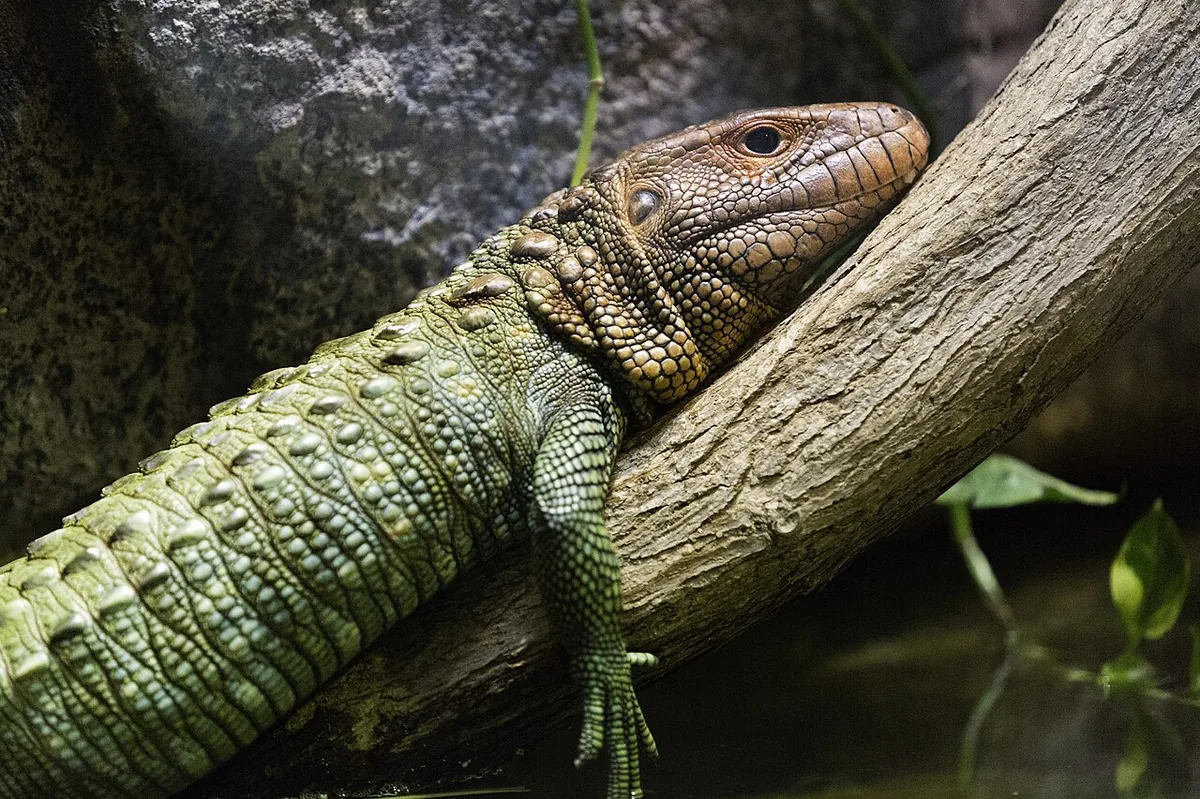
A four-to-five foot semi-aquatic lizard with bead-like crushing teeth built for eating snails. Spectacular, genuinely advanced, and the enclosure is a construction project rather than a purchase. Not an animal to buy on impulse at a show.
Caiman Lizard at a glance
| Adult size | 4-5 ft |
| Lifespan | 10+ years with good care |
| Enclosure | 8 x 4 x 6 ft minimum, semi-aquatic |
| Water | 12-18 in deep, 30-40% of floor area, canister filtered |
| Basking surface | 120-130°F (infrared thermometer) |
| Air temperature | 80-90°F warm side · 70-80°F cool side |
| Humidity | 70% or higher |
| UVB | ~12 hours daily; 5.0 juveniles, 2.0 adults |
| Diet | Aquatic snails primarily, plus crayfish and seafood |
| Supplements | Calcium twice weekly, multivitamin weekly |
| Experience | Advanced only |
What most caiman lizard care sheets get wrong
These are the errors that show up most often in secondary care sheets and forum advice. Each one is a real welfare issue, not a preference.
The snail diet is not a quirk you can substitute away.
Caiman lizards have rounded, almost bead-like molar teeth and heavy jaw and neck musculature, and that anatomy exists specifically to crush the shells of aquatic snails. Keepers who try to run them on insects and ground meat are ignoring what the animal is built to process. Snails, with crayfish and some seafood, are the diet; budget for it before buying, because it is a recurring cost that does not shrink.
The lizard is the cheap part.
A caiman lizard's purchase price is routinely a small fraction of what it costs to house one. A minimum enclosure is around eight feet long and six feet tall with a filtered, heated water section more than a foot deep, plus high-output basking and UVB. People buy the animal at a show and then discover the habitat is a months-long construction project. If the enclosure does not exist yet, the animal should not be bought yet.
Farm-raised does not mean parasite-free.
Most caiman lizards now enter the trade farmed or captive bred rather than wild-collected, which is a genuine improvement. They still commonly arrive carrying intestinal parasites, and the stress of shipping suppresses the immune system enough for a manageable parasite load to escalate quickly. A faecal screen with an exotics vet in the first weeks is normal practice for this species, not excessive caution.
Why keep a caiman lizard
- One of the most visually impressive lizards kept in captivity, and genuinely unusual
- Semi-aquatic behaviour means an animal that swims, dives and basks rather than sitting still
- Intelligent and food-motivated; many become confident with their keeper
- Diurnal, so you actually see them
- Trade animals are now largely farmed or captive bred rather than wild-collected
Why you might not want one
- The enclosure is a build, not a purchase. Very few keepers can house one properly
- Filtration and water changes make this closer to fishkeeping than to lizard keeping
- The snail-based diet is expensive and not available at a supermarket
- Imported animals commonly arrive with heavy parasite loads
- Powerful crushing jaws on a four-foot lizard deserve respect
Common questions
How big do caiman lizards get?
Adults reach four to five feet in total length and are heavy-bodied, with a long tail making up much of that. They are semi-aquatic and powerfully built, and their size combined with their need for a large water section is what makes housing them so demanding.
What do caiman lizards eat?
Primarily aquatic snails, which their rounded molar-like teeth and strong jaw muscles evolved to crush. Crayfish, other shellfish and some seafood round out the diet. This is not a preference that can be swapped for insects or meat; the animal's feeding anatomy is specialised for shelled prey.
Are caiman lizards good pets for beginners?
No. They need an enclosure around eight feet long and six feet tall containing a deep, filtered water section, a basking surface of 120 to 130°F, high humidity and a specialised snail-based diet. The combination of size, cost and complexity puts them firmly in advanced-keeper territory.
What temperature does a caiman lizard need?
A basking surface of 120 to 130°F measured with an infrared thermometer, air temperature of 80 to 90°F near the basking site, and a cool side of 70 to 80°F. Humidity should stay at or above 70 percent, and UVB should run about 12 hours a day.
How much does it cost to keep a caiman lizard?
The enclosure dominates the cost. A correct semi-aquatic habitat with filtration, heating, high-output basking and UVB typically costs many times the price of the lizard, and the snail-based diet is an ongoing expense. Budget for the habitat first and treat the purchase price as the smallest line item.
Do caiman lizards need water to swim in?
Yes. They are semi-aquatic and spend substantial time in water, so a shallow dish is not adequate. Standard guidance is a water section 12 to 18 inches deep covering roughly 30 to 40 percent of the floor area, kept clean with canister filtration because they defecate in the water.