← White's Tree Frog care guide
White's Tree Frog Enclosure and Habitat
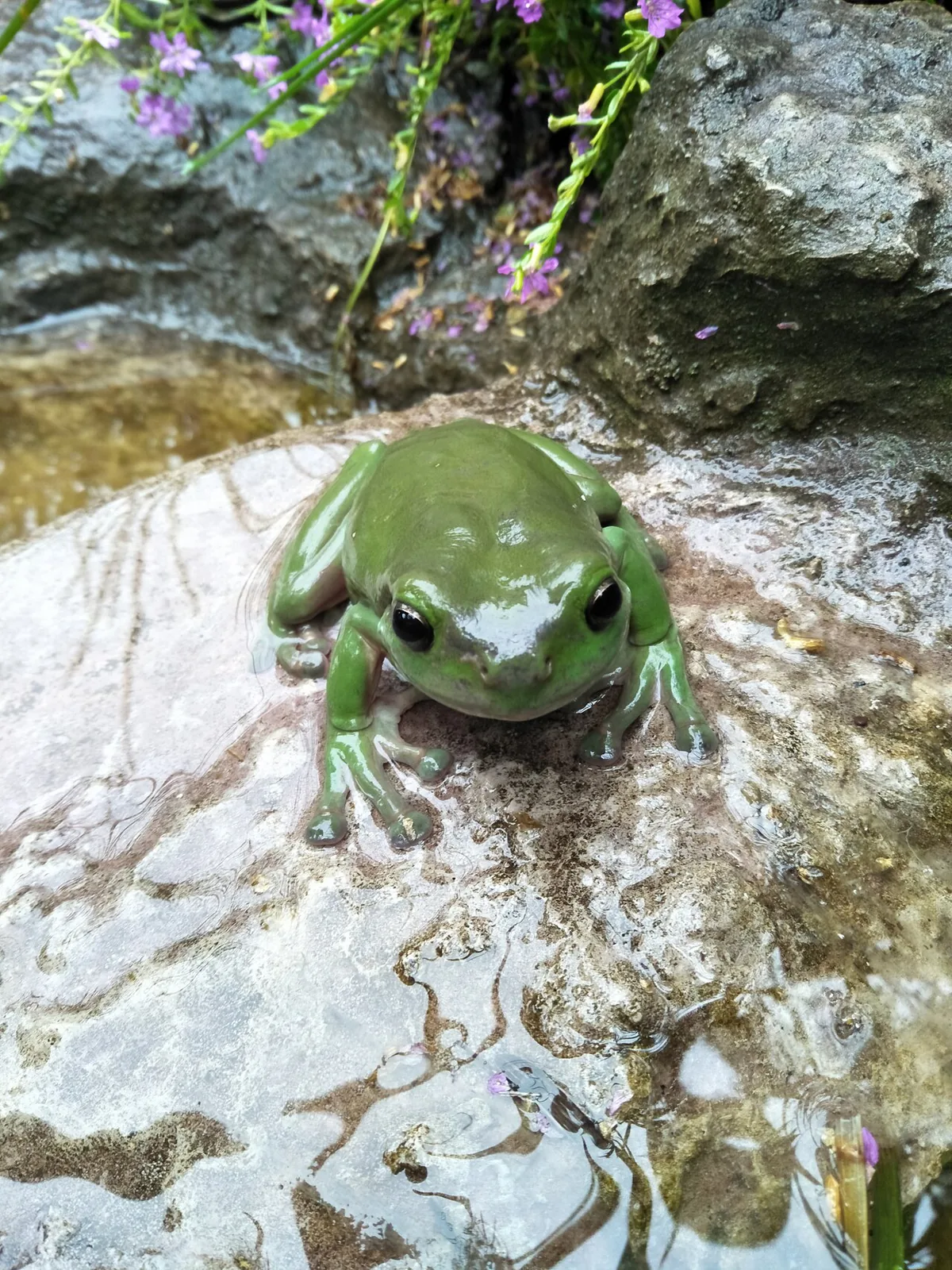
White's tree frog enclosure figures vary considerably, from a 10-gallon tank at the permissive end to a 30-gallon tall at the other. They are arboreal, so the height of the enclosure matters more than its footprint.
What published sources give
| Figure | Size | Notes |
|---|---|---|
| Higher published minimum | 30-gallon tall for a single adult | Vertical space emphasised |
| Lower published figure | 10-gallon glass tank or larger | Seen in more permissive sources |
| Orientation | Arboreal; height over floor area | They climb and perch |
| Note | This is a genuinely wide range | The taller figure suits the animal better |
Checked September 20, 2026. Where sources differ the range is shown rather than averaged. These are the figures published as minimums; none of them is a maximum.
What changes as they grow
Juvenile
Smaller enclosures are workable, with climbing structure from the start.
Adult
Published figures span 10 to 30 gallons. For an arboreal frog that spends its life on branches and leaves, the taller end is the better reading of the same evidence.
Enclosure mistakes specific to this species
Untreated tap water, or residue on anything that goes in
Amphibian skin is highly permeable and absorbs what it touches. Chlorine and chloramine in tap water, soap residue on decor, and hand lotion on a keeper's fingers all reach the bloodstream in a way they never would with a reptile. Dechlorinate everything and rinse anything new.
A lid that does not latch
Frogs are better escapers than most people expect, and a dried-out amphibian dies quickly. Lids need to latch rather than rest, particularly on climbing species.
Furnishing horizontally
A tall enclosure with decor only at the bottom gives an arboreal frog nothing. Branches, broad leaves and perching points at several heights are what makes the height useful.
Enclosure design that encourages inactivity
White's tree frogs are the most reliably overfed amphibian kept, and an enclosure with nowhere to climb compounds it. Vertical structure gives the frog something to do between meals.
Enclosure hazards that apply to almost every setup
Five hazards come up across nearly every species on this site: contact burns from unguarded heat, UVB that never reaches the animal, cutting ventilation to hold humidity, unsecured decor, and trusting a bulb's wattage instead of a thermometer. They are set out in full, with sources, on our enclosure hazards page, which is worth reading once against any setup including one that looks finished.
Signs the enclosure is wrong
Animals tell you about their housing through behaviour before they tell you through illness. None of these is a diagnosis; each is a reason to look at the enclosure and, where noted, to call a vet.
| What you see | What it can mean |
|---|---|
| Fat deposits forming a ridge above the eyes | Overweight. This species is routinely overfed. |
| Sitting on the floor rather than perching | Check climbing structure and temperature. |
| Dry or tacky skin | Humidity too low. |
| Escapes | They are stronger and more determined than they look. |
Common questions
How big an enclosure does a White's tree frog need?
Published figures range from a 10-gallon tank at the permissive end to a 30-gallon tall for a single adult. They are arboreal, so height matters more than footprint and the taller figure suits the animal better.
Do White's tree frogs need a tall tank?
Yes. They are arboreal and spend most of their time climbing and perching, so vertical space is the usable space. A tall enclosure furnished only at the bottom wastes most of it.
Is my White's tree frog too fat?
Look above the eyes. Fat deposits forming a visible ridge or overhang there are a classic sign of an overweight White's tree frog, and the species is among the most consistently overfed amphibians kept.