Crested Gecko Enclosure and Habitat
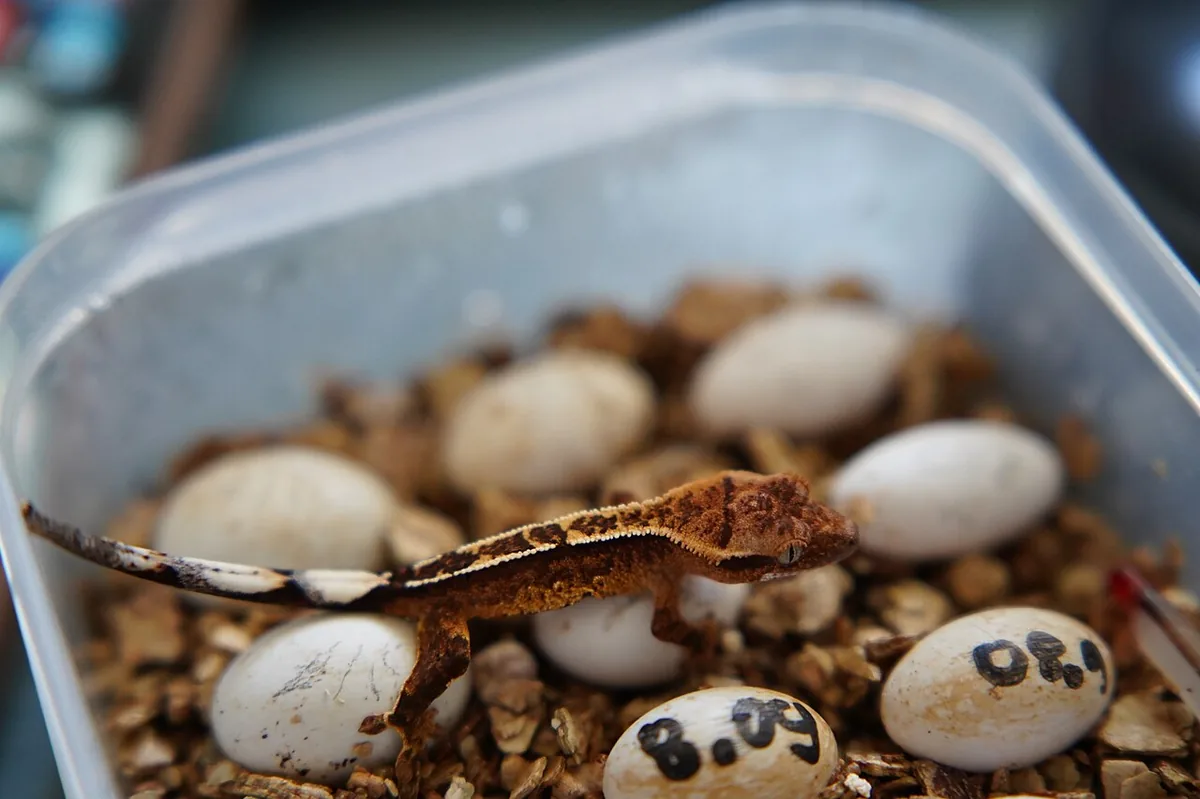
Crested geckos are arboreal, so the published minimums are given as tall enclosures rather than long ones. The figure most commonly cited for an adult is 18 x 18 x 24 inches, with taller options preferred, and juveniles are explicitly started much smaller.
What published sources give
| Figure | Size | Notes |
|---|---|---|
| Commonly published adult minimum | 18 x 18 x 24 in (~34 gal) | Taller options such as 18 x 18 x 36 are frequently preferred |
| Juvenile | Much smaller, down to a shoebox-sized tub | Stated directly in care guidance; a small gecko in a large space struggles to find food |
| Orientation | Height over floor area | Arboreal species; vertical space is the usable space |
Checked September 20, 2026. Where sources differ the range is shown rather than averaged. These are the figures published as minimums; none of them is a maximum.
What changes as they grow
Hatchling and juvenile
Care sources are unusually explicit here: juveniles should start in a much smaller enclosure, as small as a shoebox-sized tub. The reason is practical rather than about stress alone. A tiny gecko in a large planted vivarium has difficulty finding its food dish and its insects.
Adult
18 x 18 x 24 inches as the commonly published minimum, with 18 x 18 x 36 often preferred. Furnish vertically: branches, cork, and broad foliage at several heights, because the floor is the least used part of the enclosure.
Enclosure mistakes specific to this species
Buying the adult enclosure for a hatchling
This is the one species on this list where starting small is standard published advice rather than a compromise. A juvenile crested gecko in a large vivarium can genuinely struggle to find food, which is a different problem from feeling exposed.
Furnishing horizontally
A tall enclosure with decor only at the bottom wastes the space the animal actually wants. Crested geckos use height, and a bare upper third is a bare enclosure as far as the gecko is concerned.
Letting it get too warm
Crested geckos are a cool-running species, and overheating is a recognised risk. This interacts with enclosure choice, since a small glass enclosure under a heat source has far less thermal buffer than a large planted one.
Unguarded heat sources near climbing routes
Arboreal species are specifically flagged in burn guidance, because they climb toward the heat. Any bulb or emitter needs a guard, and a climbing animal will find any route you leave open.
Enclosure hazards that apply to almost every setup
Five hazards come up across nearly every species on this site: contact burns from unguarded heat, UVB that never reaches the animal, cutting ventilation to hold humidity, unsecured decor, and trusting a bulb's wattage instead of a thermometer. They are set out in full, with sources, on our enclosure hazards page, which is worth reading once against any setup including one that looks finished.
Signs the enclosure is wrong
Animals tell you about their housing through behaviour before they tell you through illness. None of these is a diagnosis; each is a reason to look at the enclosure and, where noted, to call a vet.
| What you see | What it can mean |
|---|---|
| A tail dropped with no obvious cause | Crested geckos do not regrow tails. Stress, handling and enclosure problems all raise the chance. |
| Persistent floor-dwelling in an arboreal species | Worth reading as feedback about the furnishing, temperature or the gecko's condition. |
| Stuck shed on toes and the tail tip | Usually humidity. Constricting bands can cost the gecko toes. |
| A juvenile losing condition in a large vivarium | Frequently a food-finding problem rather than a feeding problem. |
Common questions
What size terrarium does a crested gecko need?
The commonly published minimum for an adult is 18 by 18 by 24 inches, roughly 34 gallons, with taller options such as 18 by 18 by 36 often preferred. They are arboreal, so height is the dimension that matters most.
Can a baby crested gecko live in a big terrarium?
Care guidance generally advises against it. Juveniles are commonly started in much smaller enclosures, as small as a shoebox-sized tub, because a very small gecko in a large planted vivarium can have real difficulty finding its food.
Do crested geckos need a tall or a wide tank?
Tall. They are arboreal and spend most of their time climbing, so vertical space is the usable space. A tall enclosure furnished only at the bottom wastes most of what you have paid for.
Why is my crested gecko always on the floor?
It can indicate the enclosure is furnished too sparsely higher up, that temperatures are wrong, or that the gecko is unwell. In an arboreal species, persistent floor-dwelling is worth investigating rather than ignoring.