Black Rat Snake Care Guide
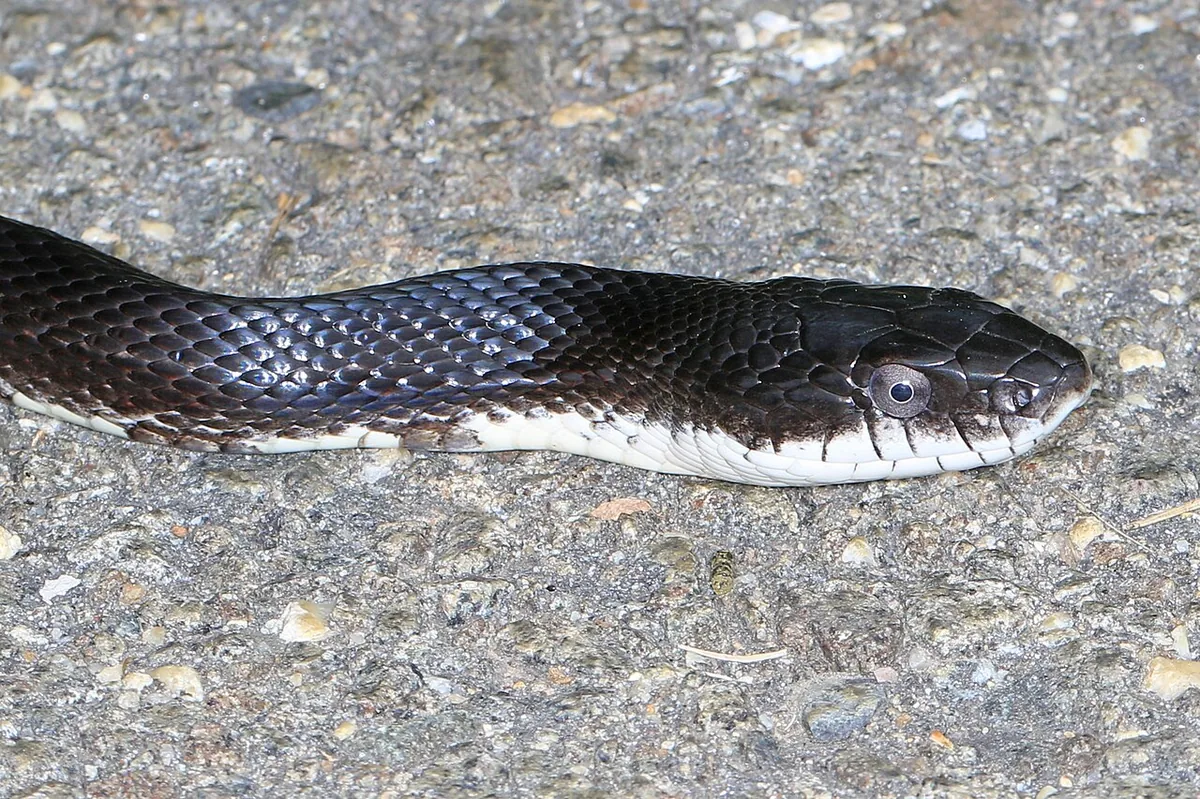
A large, glossy North American colubrid that often reaches five or six feet and is considerably more relaxed than its size suggests. The main thing keepers get wrong is the food, not the temperament.
Black Rat Snake at a glance
| Adult size | 107-183 cm (3.5-6 ft); exceptionally to 256 cm |
| Lifespan | 10-15 years wild; 20+ in captivity |
| Enclosure | Minimum ~4 x 2 x 2 ft for an adult |
| Diet | Mice as the staple; they also take birds and eggs in the wild |
| Temperament | Generally docile; bluffs by rattling the tail |
| Climbing | A capable climber, so branches and height are used |
| Experience | Beginner to intermediate, given the adult size |
What most black rat snake care sheets get wrong
These are the errors that show up most often in secondary care sheets and forum advice. Each one is a real welfare issue, not a preference.
Feed mice, not rats, despite the name.
The name invites the assumption that rats are the natural staple. In practice the black rat snake is slender-bodied for its length, and a diet of rats overfeeds it. Mice make the better staple, with prey size scaled to the snake rather than to the name on the label. Obesity in captive colubrids is common and largely a feeding-decision problem.
The tail rattling is a bluff, and it is worth knowing before it happens.
A startled black rat snake vibrates its tail rapidly, and in dry leaf litter that produces a convincing rattlesnake buzz. It is pure theatre from a non-venomous animal. New keepers and visitors read it as aggression and some animals have been killed in the wild for it. The snake is telling you it would like space.
Size is the real commitment, not temperament.
People research temperament and skip the dimensions. An adult commonly reaching five to six feet, occasionally more, with a lifespan beyond twenty years in captivity, is a long and physically large obligation. A four-by-two-by-two-foot enclosure is a practical minimum, not a target, and that footprint has to exist for two decades.
Why keep a black rat snake
- Calm and handleable for a snake of this size
- A native species with a genuinely long captive lifespan
- An active climber, so the enclosure can be interesting to build
- Straightforward feeding on an easily available staple
Why you might not want one
- Six feet of snake needs a six-foot-scale enclosure and a plan for twenty years
- The tail-rattling bluff alarms visitors and new keepers
- Not a small-apartment animal once fully grown
- Wild-caught adults are far less tractable than captive-bred animals
Common questions
How big do black rat snakes get?
Adults commonly reach 107 to 183 centimetres, roughly three and a half to six feet, and exceptional individuals have been recorded to around 256 centimetres. They are long but slender compared with a boa of similar length.
Are black rat snakes aggressive?
Generally no. They are usually docile despite their size, though a startled animal will vibrate its tail in leaf litter to mimic a rattlesnake, which reads as aggression and is actually a bluff.
What do black rat snakes eat in captivity?
Mice as the staple. Despite the name, rats tend to overfeed a snake that is slender-bodied for its length. In the wild they also take birds and eggs.
How long do black rat snakes live?
Ten to fifteen years in the wild, and over twenty in captivity with correct care. That longevity, combined with the adult size, is the real commitment.
What size enclosure does a black rat snake need?
Around four by two by two feet as a practical minimum for an adult, and larger is better. They climb, so usable height is not wasted space.