Gray Tree Frog Care Guide
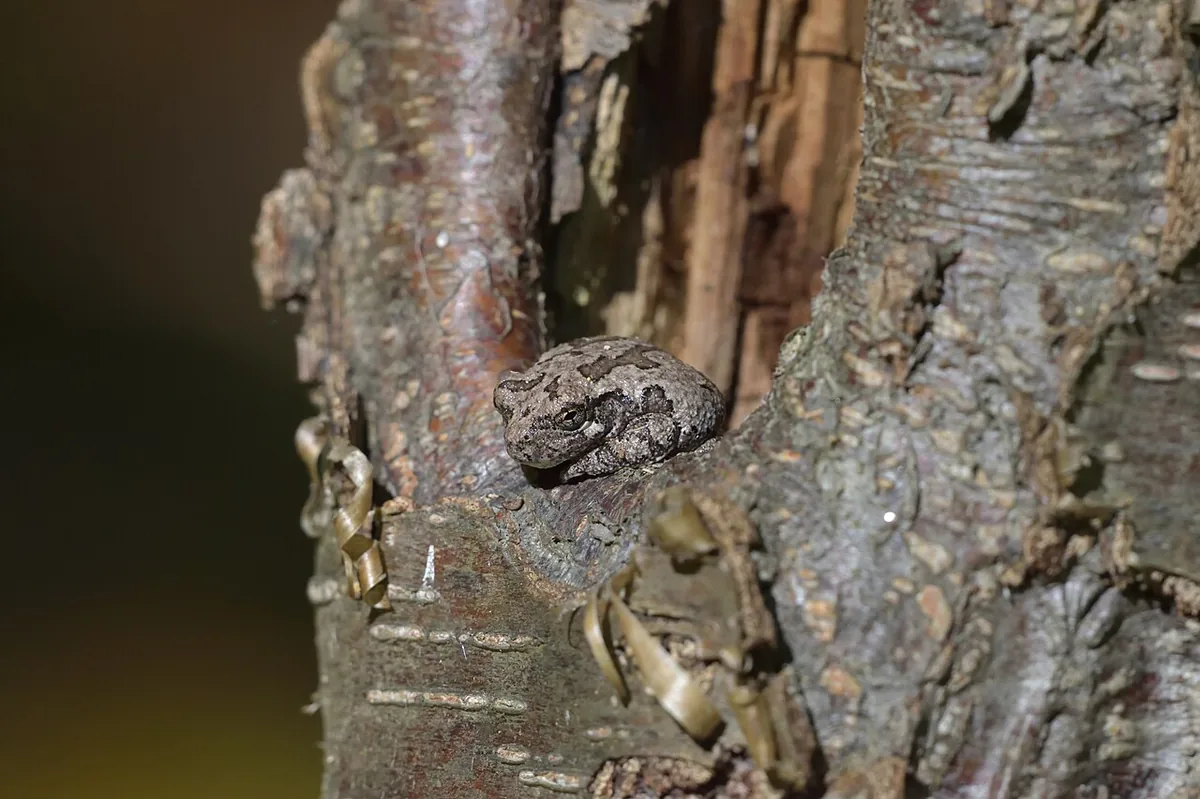
A small, superbly camouflaged North American native that changes colour between grey and green, and survives winter by letting roughly 80 percent of its body freeze solid. In captivity it is undemanding, provided the enclosure has a vertical temperature gradient.
Gray Tree Frog at a glance
| Adult size | ~2 in (5 cm) |
| Lifespan | ~5 years in captivity |
| Enclosure | 20-gallon tall (~24 x 12 x 16 in) for two adults; tight screen lid |
| Temperature | ~77-80°F at the top, 70-72°F at the bottom |
| Humidity | ~50% with a daily spike to ~80% |
| Diet | Crickets, mealworms, waxworms, hornworms; dust with calcium weekly |
| Handling | Minimal; amphibian skin absorbs what it touches |
| Experience | Beginner |
What most gray tree frog care sheets get wrong
These are the errors that show up most often in secondary care sheets and forum advice. Each one is a real welfare issue, not a preference.
This frog survives being frozen, which is not a figure of speech.
Gray tree frogs overwinter in leaf litter and under bark rather than below the frost line, and they survive it by freezing. Roughly 80 percent of the body freezes, the eyes go opaque, and breathing and heartbeat are suspended, with glycerol accumulating in the blood as a cryoprotectant. It is one of the more remarkable physiological feats in North American wildlife and it is the reason this species tolerates a wider temperature range in captivity than most tree frogs.
There are two identical species and you probably cannot tell which you have.
Dryophytes versicolor and Dryophytes chrysoscelis, Cope's gray treefrog, cannot be reliably separated by appearance. They are distinguished by call and by chromosome count, versicolor being tetraploid. Care is effectively the same, so this matters less for husbandry than for anyone trying to label an animal precisely. Be suspicious of any source that claims to tell them apart from a photograph.
Constant high humidity is the wrong target.
Tree frog care sheets often give one high humidity figure, and keepers then run the enclosure permanently wet. For this species the useful pattern is roughly 50 percent with a daily spike to around 80, which mirrors a natural day. Permanently saturated and poorly ventilated is how bacterial skin problems start.
Why keep a gray tree frog
- A hardy native that tolerates a wide temperature range
- Colour-changing camouflage between grey and green is genuinely interesting to watch
- Small enclosure footprint and inexpensive to feed
- Loud, recognisable call in males
Why you might not want one
- Small and delicate, so not a handling animal
- Live insects are an ongoing requirement
- Nocturnal, so most activity happens when you are asleep
- Often collected from the wild rather than captive bred
Common questions
How big do gray tree frogs get?
About two inches, around five centimetres, as adults. They are small, well camouflaged, and spend most of the day motionless against bark or leaves.
Can gray tree frogs really survive freezing?
Yes. They overwinter above the frost line and tolerate roughly 80 percent of the body freezing, with breathing and heartbeat suspended and glycerol acting as a cryoprotectant in the blood. It is a documented and well-studied adaptation.
What temperature do gray tree frogs need?
A vertical gradient works best: roughly 77 to 80 degrees Fahrenheit near the top of the enclosure and 70 to 72 at the bottom. Healthy animals briefly tolerate a much wider range, down to about 50 and up to about 90.
What is the difference between Dryophytes versicolor and chrysoscelis?
Essentially nothing you can see. The two are visually identical and are separated by call and by chromosome count. Captive care is effectively the same for both.
How long do gray tree frogs live?
Around five years in captivity. They are small and inexpensive, which sometimes leads to them being treated as disposable; the lifespan is a real commitment for a frog of this size.