Budgett's Frog Enclosure and Habitat
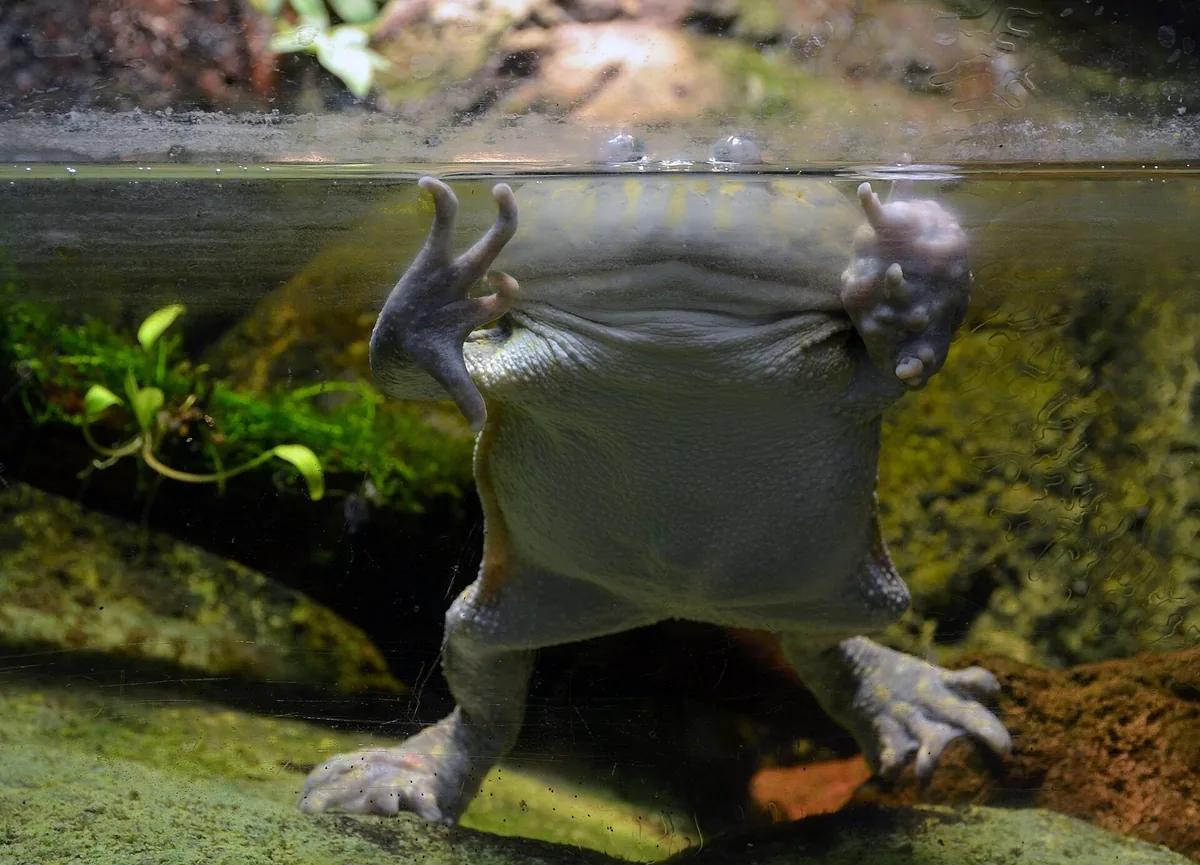
Budgett's frogs are almost entirely aquatic, so the enclosure is closer to an aquarium than a terrarium. The published figure on this site is a 60cm terrarium given over mainly to water, with a filter.
What published sources give
| Figure | Size | Notes |
|---|---|---|
| Enclosure | 60 cm terrarium, mainly water | From this site's care guide |
| Filtration | Required | They are messy feeders in water |
| Depth | Shallow enough to surface easily | They breathe air |
| Occupancy | Strictly solitary | They eat tank mates |
Checked September 20, 2026. Where sources differ the range is shown rather than averaged. These are the figures published as minimums; none of them is a maximum.
What changes as they grow
Juvenile
Aquatic from the start, with the same solitary rule. Small ones are still capable of eating each other.
Adult
A 60cm setup given over mainly to filtered water. Depth should allow easy surfacing rather than maximising volume.
Enclosure mistakes specific to this species
Untreated tap water, or residue on anything that goes in
Amphibian skin is highly permeable and absorbs what it touches. Chlorine and chloramine in tap water, soap residue on decor, and hand lotion on a keeper's fingers all reach the bloodstream in a way they never would with a reptile. Dechlorinate everything and rinse anything new.
Building a land vivarium with a water dish
This is the common misread. Budgett's frogs rarely leave the water, so the enclosure should be mainly a filtered water section rather than a terrestrial setup with a bowl in it.
Water too deep to surface easily
They breathe air and are not elegant swimmers. Depth needs to let the frog reach the surface without effort.
Housing two together
They will attempt to eat each other, and they have the teeth to make it consequential.
Enclosure hazards that apply to almost every setup
Five hazards come up across nearly every species on this site: contact burns from unguarded heat, UVB that never reaches the animal, cutting ventilation to hold humidity, unsecured decor, and trusting a bulb's wattage instead of a thermometer. They are set out in full, with sources, on our enclosure hazards page, which is worth reading once against any setup including one that looks finished.
Signs the enclosure is wrong
Animals tell you about their housing through behaviour before they tell you through illness. None of these is a diagnosis; each is a reason to look at the enclosure and, where noted, to call a vet.
| What you see | What it can mean |
|---|---|
| Struggling to reach the surface | Water too deep or too little structure. Address immediately. |
| Water fouling quickly between changes | Filtration undersized for a messy feeder. |
| Skin lesions or cloudy eyes | Water quality. Veterinary attention. |
| Repeated threat displays when approached | Normal defensive behaviour, but worth minimising disturbance. |
Common questions
What enclosure does a Budgett's frog need?
A terrarium of around 60cm given over mainly to a filtered water section. They are almost entirely aquatic and rarely leave the water, so this is closer to an aquarium setup than a terrestrial one.
How deep should the water be for a Budgett's frog?
Shallow enough that the frog can reach the surface easily, since they breathe air and are not strong swimmers. Depth should be traded for ease of surfacing rather than maximised.
Do Budgett's frogs need a filter?
Yes. They are messy feeders in water, and waste breaks down quickly in a relatively small volume. Filtration is part of the basic setup rather than an upgrade.