African Clawed Frog Care Guide
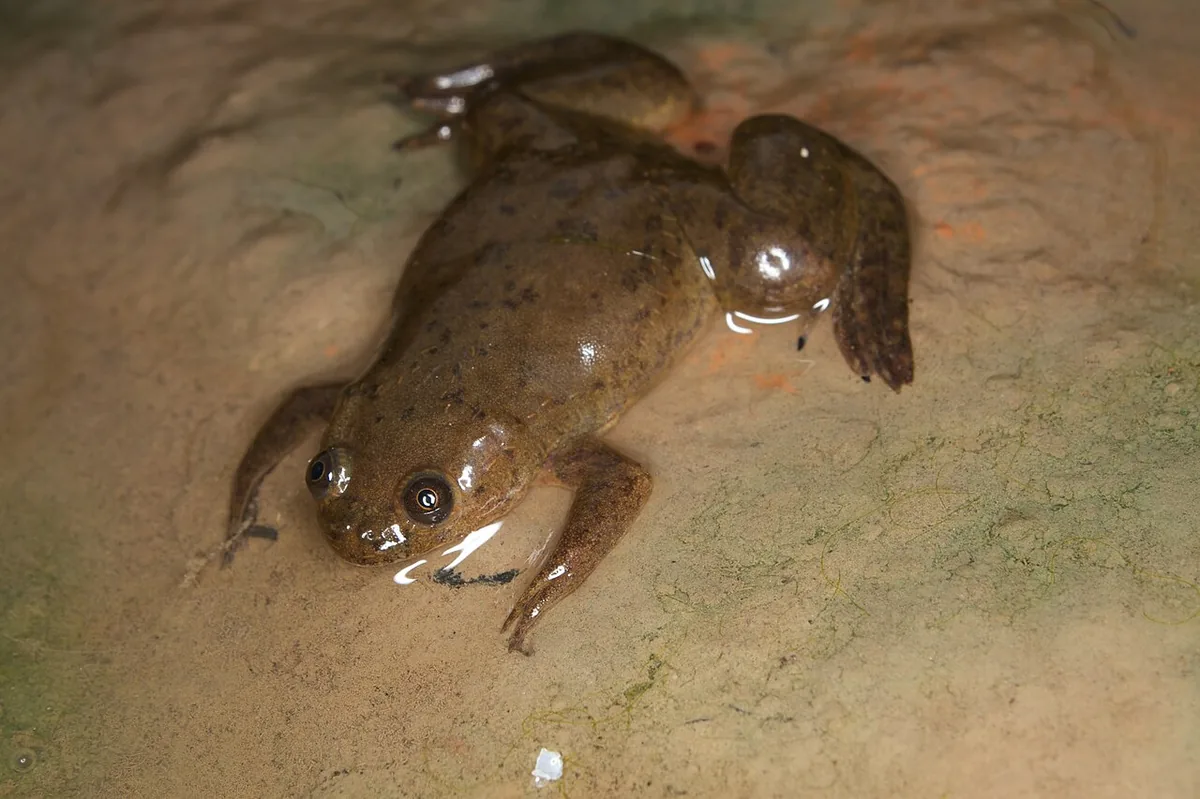
A fully aquatic frog with a laboratory history, a twenty-year lifespan, and a legal status that should be the first thing anyone checks. It is invasive where it escapes, and at least twelve states restrict or prohibit it outright.
African Clawed Frog at a glance
| Legal status | Illegal or permit-only in at least 12 US states; prohibited in Washington |
| Lifespan | 15-16 years feral; up to 20 in captivity |
| Tank | ~10 gallons for one adult; ~5 gallons per additional frog |
| Lid | Tight-fitting screen; they escape readily |
| Habitat | Fully aquatic; no land area required |
| Water | Regular changes to control bacterial build-up |
| Handling | Not a handling animal |
| Experience | Beginner, where legal |
What most african clawed frog care sheets get wrong
These are the errors that show up most often in secondary care sheets and forum advice. Each one is a real welfare issue, not a preference.
The legal status is the first husbandry question, not a footnote.
African clawed frogs are illegal to own, transport or sell without a permit in at least twelve US states, among them Arizona, California, Kentucky, Louisiana, Nevada, New Jersey, North Carolina, Oregon, Vermont, Virginia, Hawaii and Washington, where the species is classed as prohibited and may not be possessed, purchased, sold, propagated, transported or released at all. Most care sheets lead with tank size. Check the law where you live first, because in several states the correct answer is that you cannot keep this animal.
Releasing one is the harm, and it is why the bans exist.
This species is established as an invasive in parts of the United States, Chile and Great Britain, having escaped or been released from laboratory and pet populations. It competes with and preys on native amphibians and is associated with the spread of amphibian disease. A frog that lives twenty years will outlast many owners' circumstances, and the answer when circumstances change is rehoming or surrender, never a pond.
Fully aquatic means an escape is usually fatal.
Unlike most pet frogs this species has no land phase and does not climb out to bask. It is also a determined escape artist, and a frog that gets out of an uncovered tank desiccates quickly and dies. A tight-fitting screen lid is not a refinement, it is the difference between a long-lived animal and a short one.
Do not confuse it with the African dwarf frog.
The two are sold alongside each other and regularly swapped in shops. African dwarf frogs are much smaller, have webbed front feet, and are not subject to the same bans. African clawed frogs grow far larger, have unwebbed front feet with claws, and will eat tank mates small enough to fit in their mouths. Buying the wrong one is both a legal and a husbandry problem.
Why keep an african clawed frog
- Genuinely long-lived for an amphibian at up to 20 years
- Fully aquatic, so the setup is an aquarium rather than a vivarium
- Hardy and straightforward to feed where legally kept
- Active and visible, unlike many nocturnal amphibians
Why you might not want one
- Restricted or banned in at least a dozen states, and the penalties are real
- An escaped or released animal is an ecological problem, not just a lost pet
- Water quality management is an ongoing job
- A 20-year commitment in an animal often sold cheaply
Common questions
Are African clawed frogs illegal?
In at least twelve US states they are illegal to own, transport or sell without a permit, including Arizona, California, Nevada, Oregon, Washington, Hawaii, Kentucky, Louisiana, New Jersey, North Carolina, Vermont and Virginia. Washington classes the species as prohibited outright. Check your own state before buying.
How long do African clawed frogs live?
Fifteen to sixteen years in wild and feral populations, and up to around twenty in captivity. That is a long commitment for an animal that is often sold very cheaply.
How big a tank does an African clawed frog need?
Roughly ten gallons for a single adult, with about five gallons of water per additional frog. A tight-fitting screen lid is essential because they escape readily and, being fully aquatic, an escape is usually fatal.
What is the difference between an African clawed frog and an African dwarf frog?
Size and feet. Dwarf frogs stay small and have webbed front feet; clawed frogs grow much larger and have unwebbed front feet with claws. They are frequently mixed up in shops, and only the clawed frog carries the legal restrictions.
Can I release an African clawed frog into a pond?
No, and in several states doing so is illegal. The species is an established invasive in parts of the US, Chile and Great Britain, competes with native amphibians and is linked to amphibian disease spread. Rehome or surrender instead.